
Reviewed · WALKING TOURS
Walking Historical Tour
Rio history is right outside the metro. This walking tour strings together major Rio de Janeiro cultural landmarks with an easy pace and clear local context. I love the English-friendly guiding and the small-group feel, but do expect this to be an outdoor walk that may be affected by weather.
The route is built for people who like meaning, not just photos. In the positive feedback I saw, guides like Luiza De Sordi get praised for having the details ready, so you spend less time wondering and more time looking closely at what is in front of you. The group stays small, up to 15, which helps the walk stay conversational.
Timing can be a bit flexible. Depending on the day, you may see it described as about 3 hours or around 4 hours, and the tour ends near Carioca unless pickup is selected.
In This Review
- Key things to know before you go
- Entering Cinelândia at Praça Floriano, where entertainment got a name
- The National Library of Brazil, from royal gifts to world-scale archives
- Metropolitan Cathedral and Real Gabinete, architecture lessons in two very different languages
- Colombo confectionery, Belle Époque details you can spot like a pro
- From Praça do Comércio to Cultural Center, a building that kept changing jobs
- Candelária Church, where a storm story turns into one of Rio’s tallest domes
- Praça Quinze de Novembro, Republic day memories and a view toward Ilha Fiscal
- Price, group size, and the value equation at $127.42
- Practical tips for walking it well in Rio
- Should you book this Cinelândia to Candelária historical walk?
- FAQ
- What languages are available for the walking historical tour?
- How long is the tour?
- Where does the tour start and end?
- Is a guide included?
- Are there admission fees for the stops?
- Is pickup available?
- Is food or drinks included?
- What is the group size limit?
- What happens if the weather is bad?
Key things to know before you go
- English, Italian, and Spanish are offered
- Small groups, up to 15 travelers
- Mobile ticket for a smoother start
- Pickup is available (choose it if you want it)
- Many planned stops have free admission
- Smart casual dress code for the walking portion
More of Rio covered on foot:
- Rio de Janeiro: Rocinha Favela Walking Tour with Local Guide
★ 4.8 · 3,052 reviews - Rio De Janeiro: Half-Day Rocinha Favela Walking Tour
★ 4.7 · 2,272 reviews - 3 Hour Rocinha Favela Walking Tour with a Local Guide
★ 5.0 · 833 reviews - Favela Tour Rio de Janeiro – Vidigal Walking Tour by Russo Guide
★ 5.0 · 377 reviews
Entering Cinelândia at Praça Floriano, where entertainment got a name
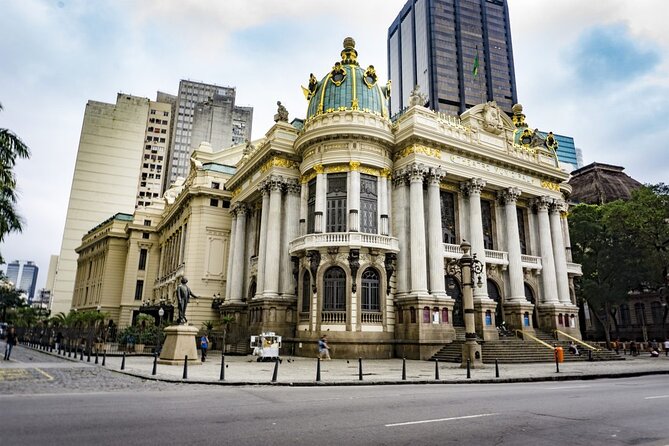
You start in Cinelândia at Praça Floriano, a square sitting on part of the old Convento da Ajuda land. It helps to know that this area took a big turn in the early 1900s, when the convent was demolished in the first decade of the 20th century. That change set the stage for Cinelândia to become the entertainment hub people associate with central Rio today.
What I like most here is the way the tour connects architecture to culture. The square is surrounded by heavy hitters like the National Library, the City Hall (Palácio Pedro Ernesto), the former Federal Supreme Court, the Monroe Palace, and the Municipal Theater. The idea of shaping this zone into a Brazilian version of Times Square is tied to businessman Francisco Serrador, a Spanish entrepreneur in Brazil behind casinos, cinemas, theaters, and hotels (with casinos now prohibited). By the 1930s, the name Cinelândia was already in common use.
If you are the type who enjoys seeing how a city’s identity forms over time, you will get a lot out of this opening block. Your guide will likely point out details you might miss if you were just passing through. The main trade-off is that you are starting in a busy, central area, so bring patience for street movement before the walk settles into a comfortable rhythm.
The National Library of Brazil, from royal gifts to world-scale archives
Next comes the National Library of Brazil, officially the Fundação Biblioteca Nacional. Even from the outside, it is a powerful stop because the scale is the story. This library is recognized by UNESCO as one of the ten largest national libraries in the world, and the largest in Latin America.
The historical thread goes back to 1808, when the Portuguese royal family arrived in Brazil. Dom João VI brought a set of works of art that later became part of the collection that shaped the institution. The king also founded the Royal School of Science, Arts and Crafts, which is a reminder that the library was tied to learning systems, not only shelves.
What I like is how the tour frames the library as something that evolved with Brazil itself. In 1826, Emperor Pedro I renamed it the Academia Imperial de Belas Artes. Over time, the academy formed major components like an art gallery and a glyptotheque. Then, with the Republic, the name shifted again to the Escola Nacional de Belas Artes.
For your planning, treat this stop as a chance to slow down. You will be close enough to appreciate the building and its role in Rio’s cultural life, without committing to a long museum-style visit. The downside is that if you want a deep, hours-long library dive, this walking tour is not built for that. It is built for getting your bearings fast, then moving on while the city is still fresh in your mind.
Metropolitan Cathedral and Real Gabinete, architecture lessons in two very different languages
Two of the most striking religious and cultural landmarks come next.
First is the Catedral Metropolitana de São Sebastião do Rio de Janeiro, inaugurated in 1979. The most distinctive part is the conical shape and the straight, sober lines that give the building a strong geometric personality. Then comes the detail that makes people stop and look up: the colorful stained glass windows that reach toward the top.
This is a free-admission stop with about 20 minutes scheduled. That time is enough to notice the big form and then shift your attention to the stained glass. If you go in expecting a quiet, reflective experience only, you might be surprised by how much the space plays with light and angle. The cathedral is designed to make your viewpoint part of the scene.
After that, you move to the Real Gabinete Portugues da Leitura. This place is a cultural institution founded in 1837 by a group of 43 Portuguese immigrants, political refugees who wanted to promote culture within the Portuguese community in the Empire’s capital at the time. The architecture is in the neomanueline style, which evokes the exuberant Gothic-renascentist mood tied to Portuguese discoveries.
The stop is about 30 minutes and listed as free. If you enjoy architecture, you will likely appreciate how the style signals identity, like a visual map of where the founders came from and what they wanted to build.
A practical consideration: both stops are visually intense. If you have a short attention span, you might want to focus on one theme at each place, like stained glass at the cathedral and design symbolism at Real Gabinete. That way you leave with clear takeaways instead of a blur of facts.
Colombo confectionery, Belle Époque details you can spot like a pro
After the cathedral and library institutions, you get a different kind of history: food culture and elegant design at Colombo.
The confectionery was founded in 1894 by Portuguese immigrants Joaquim Borges de Meireles and Manuel José Lebrão. This stop is a treat because it connects “what people ate” with “how a city wanted to look” in the early 1900s. The architecture and interiors are meant to evoke the Belle Époque.
Here is what you will likely hear highlighted. In the early 20th century, the interior halls were renovated with an Art Nouveau touch. Huge crystal mirrors were brought from Antwerp, framed by elegant friezes carved in rosewood. The wooden furniture was carved by artisan Antônio Borsoi. Later, the business expanded with a second floor tea room. A ceiling opening lets you see the skylight above the tea room, decorated with stained glass.
The stop is listed at about 20 minutes, and admission is free. You are not required to buy anything as part of the tour, but food and drinks are not included overall. If you want a sweet break, this is a good place to pause. If you do not, simply treat it as a designed interior you can study without a ticket fee.
The potential drawback is simple: if you are not into interiors and materials, Colombo can feel like a short detour compared to the bigger streetscape stops. But if you do like craftsmanship, you will probably feel like you earned a souvenir even without purchasing one.
From Praça do Comércio to Cultural Center, a building that kept changing jobs
The next landmarks bring you back to the civic and commercial heart of Rio.
You will see a historic building in neoclassical style designed by the French architect Grandjean de Montigny, ordered by D. João VI. It was inaugurated on May 13, 1820, aiming to establish the First Praça do Comércio in Rio. That early purpose matters because it explains why this zone is full of institutions with official gravity.
Over the years, the building served several functions. It housed Customs, the Archives of the Ítalo-Germanic Bank, and the II Jury Court. Then, in 1990, it opened as a Cultural Center. This tour treats the changing roles as part of the lesson, not as trivia. You start to see how Rio’s power structure moved, but the walls stayed.
In a walking tour format, you will likely focus on exterior details and guided context rather than deep inside access. If you love architectural typography, sculptural details, and the look of civic buildings, this stop will land well. If you wanted a museum ticket included for every major sight, you might feel there is not enough time here. That is the trade-off for having a tight, efficient route.
More of Rio's older story on foot:
- Rio de Janeiro Historical Center Walking Tour★ 4.5 · 336 reviews
- Private Walking and Cultural Tour Rocinha-Rio de Janeiro★ 5.0 · 239 reviews
- Discover Rio Little Africa: A Cultural and Historical Journey★ 5.0 · 238 reviews
- Rio de Janeiro: Historic Rio and Santa Teresa Half-Day Tour★ 4.4 · 228 reviews
- Rio de Janeiro: Little Africa Heritage Walking Tour★ 4.9 · 177 reviews
Candelária Church, where a storm story turns into one of Rio’s tallest domes
The tour then heads toward Candelária, a place with a long origin story and a dramatic visual impact.
The hermitage dates to 1609, built by Portuguese Antônio Martins Palma and Leonor Gonçalves. The story centers on a storm at sea while they traveled on a ship called Candelária. Promising to build a hermitage if they survived, they fulfilled that vow by creating the Candelária shrine.
The building history moves through renovations and additions across the 18th century. In 1710, work started on the parish church of Candelária. The church was inaugurated in 1811 with the Prince Regent D. João VI present, at a time when the church still had only one nave. Later, after interventions by several architects, the dome was completed in 1877.
The technical details here are the kind that make the building feel real. The dome sections were made in Portuguese limestone in Lisbon, and eight statues decorate it, sculpted by Portuguese José Cesário de Salles. When finished, the dome became the tallest building in the city, about 62.24 meters from floor to dome top, visible from a distance.
For you, this is one of the strongest stops because it gives you both story and scale. Even if you have seen churches before, this one reads like a timeline. The caution: domes and churches make people want to photograph from every angle, so wear the patience to handle a little crowd choreography.
Praça Quinze de Novembro, Republic day memories and a view toward Ilha Fiscal
You close with Praça Quinze de Novembro, a square with origins that go back to the 16th century. Jesuits built a hermitage facing Piaçaba beach in this area, on land tied to older city geography. The square has had many names over time, including Largo do Terreiro da Polé, Largo do Carmo, Carmo Square, Terreiro do Paço, and Largo do Paço.
Then it gets its current name from November 15, 1889, the day the Republic was proclaimed in Brazil. The tour connects that date to visible symbols nearby, including the Imperial Palace and the Tiradentes Palace. You will also hear about the Mestre Valentim Fountain and several statues.
Some of the statues have strong historical links:
- Dom João VI
- General Osório, connected to the Paraguayan War
- The Statue of the Black Admiral, honoring João Cândido, who led the Revolt of the Lash in 1910
Finally, the square offers a beautiful view toward Ilha Fiscal. This is a smart way to end a walking history route. You get a broader perspective that helps the central city feel connected, not like separate stops.
The stop is listed at about 15 minutes and free admission. That is a good length to soak it in without rushing. If you have time, linger after the tour ends, especially for the view.
Price, group size, and the value equation at $127.42
The price is $127.42 per person for an experience that runs roughly 3 hours, sometimes described closer to 4 hours. On paper, that might sound like a lot for a walking tour. In practice, the value comes from three things you do not want to skip in Rio’s center: a professional guide, organized pacing across key institutions, and free or low-friction entry at several major stops.
You get a guide, and the tour is capped at a maximum of 15 travelers. That small group matters because it makes it easier to ask follow-up questions and stay engaged while you move. Also, multiple stops are listed as ticket free, which reduces the hassle of figuring out what costs extra.
What is not included is also important. Food and drinks are on you, and drop-off is not included. So I treat the price as paying for curated context and guided movement, not for a full-day meal plan or taxi-style convenience.
If you are coming from out of town or you want to understand the center without getting lost, this can be a strong use of your limited time. If you already know this history and mainly want to do building interiors, you might feel more satisfied with museum tickets and a self-guided route. The best match is someone who wants a guided storyline.
Practical tips for walking it well in Rio
A few details will help your day go smoother.
First, plan for weather. The tour requires good weather, and if it gets canceled due to poor weather, you should expect a different date or a full refund. That means you should avoid locking this tour into a day with a tight backup plan.
Second, dress smart casual. Since this is a walking tour, you will likely want comfortable clothes you can move in, not something fussy.
Third, use transit. The meeting point is in Cinelândia at Praça Floriano in Centro, and the tour is near public transportation. The tour ends in Carioca Centro at a square with two metro exits facing Santo Antonio hill. So even without drop-off, you have an easy way to keep going.
Fourth, bring your phone habits. You get a mobile ticket, which usually makes check-in simpler than printing. It also helps you keep the day organized without losing paper.
Fifth, plan around food. Food and drinks are not included, so decide where you want a break, especially before or after Colombo, which is set up like a proper café experience.
Language note: the tour is offered in English, Italian, and Spanish. If English is your best language, you will likely appreciate how much faster the storytelling lands when you do not have to translate in your head.
Should you book this Cinelândia to Candelária historical walk?
I recommend booking if you want a guided tour that connects Rio’s layers quickly: royal-era culture at the National Library, distinctive architecture at the Metropolitan Cathedral and Real Gabinete, Belle Époque interiors at Colombo, and a closing Republic-era feel at Praça Quinze de Novembro with a view toward Ilha Fiscal.
I would skip or pair it with something else if you mainly want deep museum time or long stays inside major venues. This is designed as an efficient walking route with short visits and strong interpretation, not a slow, detailed museum marathon.
One more call-making tip. Look at your tolerance for outdoor time and your appetite for architecture and civic history. If those are your things, this is a smart, time-efficient way to understand central Rio without drowning in information.
FAQ
What languages are available for the walking historical tour?
The tour is offered in English, Italian, and Spanish.
How long is the tour?
It is listed as about 3 hours (approx.), and the experience description also notes an approximately 4 hour tour depending on the day.
Where does the tour start and end?
It starts at Cinelândia, Praça Floriano in Centro, Rio de Janeiro, and ends in Carioca, Centro at a square with two metro exits facing the Santo Antonio hill.
Is a guide included?
Yes. A professional guide is included.
Are there admission fees for the stops?
Several of the planned stops list free admission (including Cinelandia, the Metropolitan Cathedral, Real Gabinete Portugues da Leitura, Colombo, and Praça Quinze de Novembro). Other stops may not list a specific admission detail.
Is pickup available?
Pickup is offered, and it affects where the tour begins and where it ends. If you select pickup, the tour can work differently than the default start and end points.
Is food or drinks included?
No. Food and drinks are not included.
What is the group size limit?
The tour has a maximum of 15 travelers.
What happens if the weather is bad?
The experience requires good weather. If it is canceled due to poor weather, you will be offered a different date or a full refund.
Recently added around Rio



Walking Tours, compared.

3 Hour Rocinha Favela Walking Tour with a Local Guide
Read our review →
Favela Tour Rio de Janeiro – Vidigal Walking Tour by Russo Guide
Read our review →
Private Walking and Cultural Tour Rocinha-Rio de Janeiro
Read our review →

Sunrise and Sunrise Walk Two Brothers with Local Guide
Read our review →More of this kind of Rio day