
Reviewed · WALKING TOURS
Rio Historic Center Walking Tour with Typical Brazilian Lunch
If you like your Rio fast, this walking loop hits the highlights. You start in Cinelandia, then wind through the Historic Center to street-art stops, cathedral interiors, and panoramic terraces, ending with lunch. It is a tight, guided way to understand how different parts of the city connect.
I love that the route mixes big-name landmarks with real neighborhood details you might miss on your own. Two standout things for me: the Selarón Escadaria, with its colorful story, and the Lapa Arcos, where the old aqueduct and today’s graffiti sit side by side. I also like the pacing, with short stops that let you look closely without feeling rushed.
One thing to consider: you are walking through a dense central area, including stairs and viewpoints, so bring comfortable shoes and plan for some uphill moments near the hill areas.
In This Review
- Key things that make this tour worth your time
- Cinelandia Square, where Rio’s “grand” side starts
- Selarón Escadaria, the stairs that feel personal
- Lapa Arcos and the aqueduct that kept the city alive
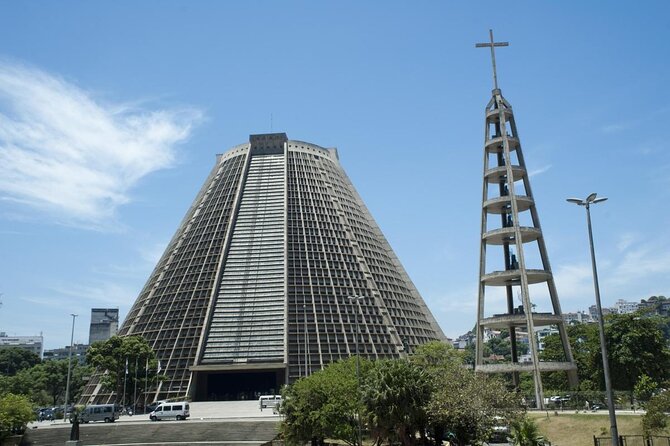
- Metropolitan Cathedral of Saint Sebastian, stained glass you can actually see
- Largo da Carioca, two churches close together and worth your time
- Confeitaria Colombo and Praça Quinze de Novembro: old Rio with a grand stage feel
- Praça Pio X, Candelária area, and São Bento’s monastery church
- Mauá Square, the Etnias mural, and the Olympic-era tram back to lunch
- Price and value for a 5-hour Historic Center loop
- Who this tour fits best
- Should you book this Rio Historic Center tour with lunch?
- FAQ
- How long is the Rio Historic Center walking tour?
- Where does the tour start and what time does it begin?
- Is lunch included?
- How large are the groups?
- Are entrance tickets included for the stops?
- What happens if I cancel?
Key things that make this tour worth your time
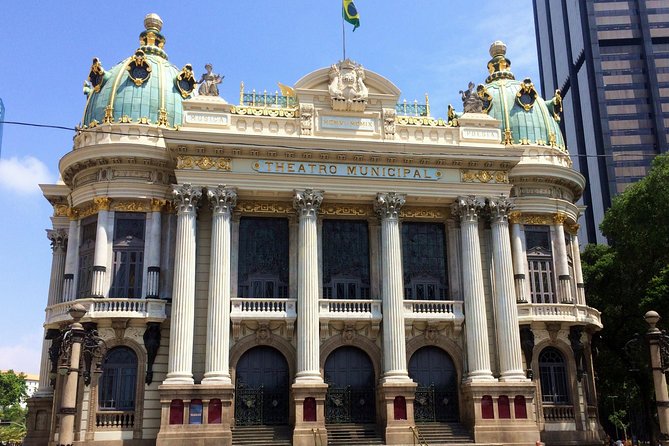
- Cinelandia Square: major buildings in one spot, including Teatro Municipal and Biblioteca Nacional
- Selarón Escadaria: George Selaron’s long project, visible up close and personal
- Lapa aqueduct area: XVIII-century Arcos with modern graffiti energy
- Church and cathedral interiors: stained glass at the Cathedral of Saint Sebastian, baroque highlights at neighboring churches
- A classic stop for lunch: Confeitaria Colombo sets a true Centro mood before your included meal
- Street art and a big mural stop: the Etnias mural by Eduardo Kobra tied to the Olympic Games
Other midday stops folded into the drive:
- Rio de Janeiro: 6-Stop Highlights of Rio with Lunch
★ 4.4 · 5,157 reviews - Rio’s City Tour – Tickets for Christ, Sugar Loaf & Lunch included
★ 5.0 · 4,389 reviews - Full Day: Christ Redeemer, Sugarloaf, City Tour & Barbecue Lunch
★ 4.5 · 3,142 reviews - Rio’s Full Day: Selarón Steps, Christ & Sugarloaf – Tickets & Lunch Included
★ 5.0 · 2,724 reviews
Cinelandia Square, where Rio’s “grand” side starts
You begin in Copacabana at the Copacabana Palace, A Belmond Hotel. That matters because it keeps you from having to figure out a tricky start location on your own. It also sets the tone for a day that feels like a guided orientation to downtown.
Cinelandia is the classic Rio “stage” square. You are surrounded by institutional buildings and cultural landmarks, not just storefronts. The Teatro Municipal grabs your attention right away, and you also pass by the Museu de Bellas Artes and the Biblioteca Nacional. This is one of those places where you can see why Rio wanted to look serious, modern, and European at different points in its history.
You will also notice the little specifics. The itinerary includes the Le Teatro Odeon, the cinema in the square that is still in operation. That is the kind of detail that makes the walk feel lived-in instead of like a photo checklist.
Selarón Escadaria, the stairs that feel personal
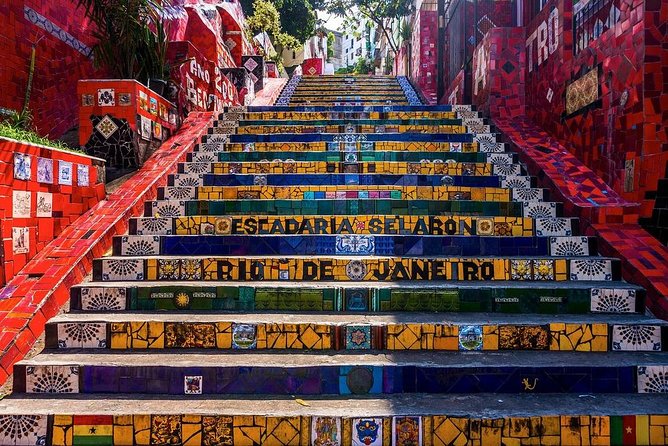
After Cinelandia, the route heads toward Lapa, passing by the famous multicolored staircase of George Selaron. This is not just decoration. It is a long, ongoing work created by a Chilean artist over about twenty years. The point is not the speed of the visit. The point is standing there long enough to see the textures and the mix of colors and objects.
From street level, the staircase becomes a story you can read with your eyes. It is also an easy way to understand how street culture became part of Rio’s identity. Even if you only know Rio from beaches, this is where the city shows you its creative side.
Practical note: you will spend time looking, but you are also moving through a busy area. Keep your phone secure and give yourself room to step aside when groups form.
Lapa Arcos and the aqueduct that kept the city alive
Next comes the Arcos da Lapa, a dramatic set of arches tied to an old Rio aqueduct. This aqueduct dates from the XVIII century and supplied water to the city until the end of the XIX. That detail changes how you look at the place. It is not just a pretty structure for photos. It is infrastructure that helped Rio function.
The walls here are covered with graffiti, and you get both at once: historic stone arches and modern street art. It is a very Rio contrast, and the guided storytelling makes the connection click.
One more neat detail: the tram passes through the aqueduct to access Santa Teresa. You might see it in your route, and it helps you understand why this area became a transportation and cultural hub, not just a landmark spot.
Metropolitan Cathedral of Saint Sebastian, stained glass you can actually see
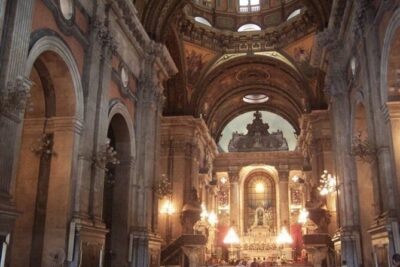
At the Cathedral of Saint Sebastian, you go inside. That is a big deal because so many historic sites are just viewed from the outside. Here, the guide focuses on the cathedral’s architecture and its history, plus its monumental stained glass windows.
Stained glass can be tricky if you rush. Inside, you get the chance to slow down and notice how the light interacts with the windows. It is also an opportunity to understand the cathedral as a historical object, not only a pretty interior.
If you care about design and meaning, this stop is one of the most rewarding on the route because it gives you context for what you are seeing.
Largo da Carioca, two churches close together and worth your time
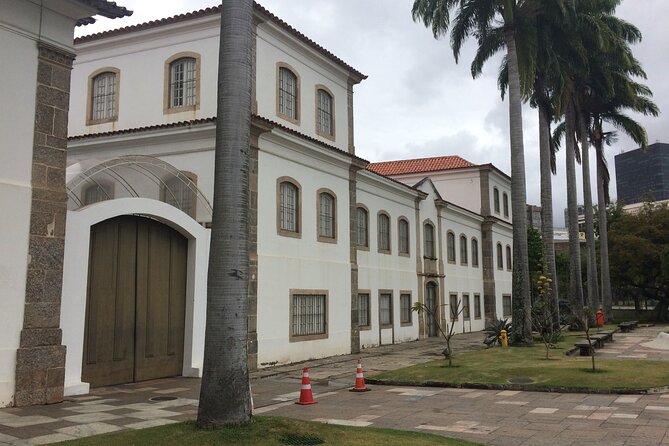
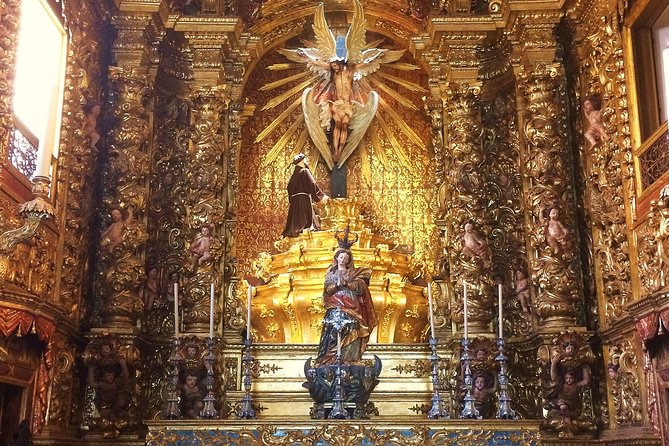
Largo da Carioca is one of the stops where the itinerary makes smart choices. You walk past the Sao Antonio church and Sao Francisco da Penitencia, which includes one of the most beautiful baroque churches in Brazil. The baroque label can sound vague, but the idea is visible in the way the church is made to impress: decoration, drama, and a strong visual presence.
Right next to these churches is also the panoramic view from the terrace, and that is part of the value here. You are combining interior appreciation with an outdoor perspective, so you leave with both details and context.
The stop includes admission, so you are not scrambling to figure out ticketing. You just enjoy the architecture and the view.
More of Rio covered on foot:
- Rio de Janeiro: Rocinha Favela Walking Tour with Local Guide★ 4.8 · 3,052 reviews
- Rio De Janeiro: Half-Day Rocinha Favela Walking Tour★ 4.7 · 2,272 reviews
- 3 Hour Rocinha Favela Walking Tour with a Local Guide★ 5.0 · 833 reviews
- Favela Tour Rio de Janeiro – Vidigal Walking Tour by Russo Guide★ 5.0 · 377 reviews
- Rio de Janeiro Historical Center Walking Tour★ 4.5 · 336 reviews
Confeitaria Colombo and Praça Quinze de Novembro: old Rio with a grand stage feel
After Largo da Carioca, you move through pedestrian streets to Confeitaria Colombo. This is one of Rio’s oldest cafes and it has an art deco style that makes it feel like a time capsule inside the Centro. Even if you do not sit for long, you get a real sense of atmosphere. Old Rio is not only monuments. It is also the spaces where people paused, talked, read, and waited.
Then you reach Praça Quinze de Novembro, tied to the proclamation of the Republic. This is another “big square” stop, and the guide points out key sights around it: the Church of Our Lady of the Carmelites, the Paço Imperial, and the Equestrian Statue of General Osorio. You also get the Tax Island area and the ferry pier to Niteroi and Paqueta in Guanabara Bay.
This is where a guided walk helps a lot. From street level, you might not instantly grasp how these landmarks relate to the Republic era and to Rio’s role as a port city. The narration gives you the thread.
Praça Pio X, Candelária area, and São Bento’s monastery church
The tour continues to Praça Pio X and nearby pedestrian streets. Here the itinerary includes the Candélaria church, the Olympic boulevard, the CentrO Cultural do Banco do Brasil, and casa França Brasil. Even if you do not spend long at each exact spot, the guide connects the dots by pointing out what each building represents in Rio’s public life and cultural scene.
Then comes the Mosteiro de Sao Bento. This monastery church is called one of the most beautiful churches in Rio, and the stop focuses on its history. That matters, because a monastery church can feel “just pretty” if you only look at the surface. With the background, it becomes part of a larger story of how Rio’s religious and cultural identity developed.
If you like architecture and you enjoy being told what to look for, these two stops together make the day feel like more than sightseeing. They feel like understanding.
Mauá Square, the Etnias mural, and the Olympic-era tram back to lunch

Near Mauá Square, you get a modern contrast. The itinerary mentions the Museu de Amanha, Museum of Tomorrow, but it also notes that it is not visited. That is useful to know ahead of time, because it keeps expectations realistic. You can still appreciate why this area is architecturally interesting, and the view connections make sense for the rest of the stops.
You also get the Art Museum of Rio’s panoramic terrace on the top floor, with views that can include Mauá Square, the Niteroi Bridge, and the Museum of Tomorrow. Even just hearing what you might be able to see helps you orient fast.
Then you head to the Etnias mural, also called Estúdio Kobra. This is a large mural considered one of the largest in the world, representing five ethnic groups. It was produced by Eduardo Kobra for the Olympic Games. This stop is a reminder that Rio’s street art and international events are connected, and that public art can carry big meaning.
Finally, you head to Santo Cristo and take the tram built by Alsthom for the Olympic Games, back toward Cinelandia. That is a clever ending because you return on a familiar tourist-friendly path while still using something connected to recent Rio history.
Lunch wraps up the experience back at Cinelandia. The lunch is included, and it is positioned as a proper Brazilian meal after all the walking and looking. This is a practical advantage: you do not waste your afternoon trying to hunt for a place that matches your schedule.
Price and value for a 5-hour Historic Center loop
At $126.15 per person for about 5 hours, the biggest question is what you get for your money. You get a guided route through a concentrated cluster of major sights, plus an included lunch. Most entrance tickets on the stops are free, and the itinerary only flags one included admission at Largo da Carioca.
So the value is mostly about your guide, your time, and the “thinking” part of a tour. A good guide helps you notice details you would otherwise skim past. And because the group size is capped at 12 travelers, you are more likely to get responsive explanations and keep a decent pace through crowded areas.
If you are short on time and you want a clean introduction to the Historic Center, this is a sensible use of your day. If you want to spend lots of hours at museums or go off-script for long independent wandering, you might prefer a slower plan.
One more reason this tour can feel good: a standout review mentioned Antoine, a French guide living in Rio for about 8 years, and the way he connected history and the city’s many faces. You should not expect the exact same guide, but it does tell you the tour is built around thoughtful local storytelling.
Who this tour fits best
I think this is best for you if:
- You want a first or second day in Rio kind of understanding of the Historic Center
- You like churches, public squares, and street art in one coherent route
- You prefer a small group with a guide who explains what you are seeing
- You want an included lunch so your day stays smooth
It may be less ideal if you:
- Plan to do lots of independent museum time and do not want set stops
- Have limited mobility and know you will not handle the walking and stair-adjacent areas comfortably
- Want a fully flexible itinerary where you can roam longer on your own
Should you book this Rio Historic Center tour with lunch?
Yes, if your goal is to get oriented quickly and see Rio’s “layers” in a short window. The combination of Cinelandia culture, Selarón’s personal street-art story, the Lapa aqueduct arches, and the church interiors makes the walk feel like a timeline you can walk through.
Book it especially if you like your sightseeing guided, not just photographed. The included lunch is also a quiet value win, because it prevents you from turning your final hour into a search mission.
Skip it if you already know the Historic Center well and you want long museum stays, because the structure here is designed for breadth, not deep solo exploration.
FAQ
How long is the Rio Historic Center walking tour?
The tour lasts about 5 hours.
Where does the tour start and what time does it begin?
The meeting point is the Copacabana Palace, A Belmond Hotel in Copacabana, and the start time is 9:00 am.
Is lunch included?
Yes. Lunch with the guide is included, served as part of the tour after you return toward Cinelandia.
How large are the groups?
The tour has a maximum of 12 travelers.
Are entrance tickets included for the stops?
Most admissions are free in the itinerary. One stop, Largo da Carioca, lists admission as included.
What happens if I cancel?
This experience is non-refundable and cannot be changed for any reason. If it is canceled due to not meeting the minimum number of travelers, you will be offered a different date or a full refund.
Rio's Older Story on Foot
- Private Walking and Cultural Tour Rocinha-Rio de Janeiro
★ 5.0 · 239 reviews - Discover Rio Little Africa: A Cultural and Historical Journey
★ 5.0 · 238 reviews - Rio de Janeiro: Historic Rio and Santa Teresa Half-Day Tour
★ 4.4 · 228 reviews - Rio de Janeiro: Little Africa Heritage Walking Tour
★ 4.9 · 177 reviews
Recently added around Rio




Walking Tours, compared.



3 Hour Rocinha Favela Walking Tour with a Local Guide
Read our review →
Favela Tour Rio de Janeiro – Vidigal Walking Tour by Russo Guide
Read our review →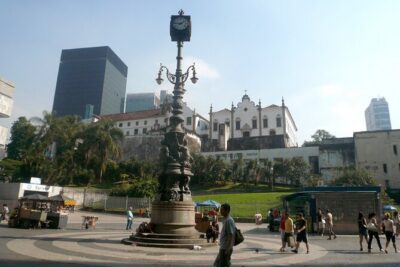
Private Walking and Cultural Tour Rocinha-Rio de Janeiro
Read our review →

Sunrise and Sunrise Walk Two Brothers with Local Guide
Read our review →More of this kind of Rio day