
Reviewed · WALKING TOURS
Historical Rio Walking Tour
Old streets, new insights, right on foot. This historical Rio walking tour threads together downtown landmarks with a guided, small-group pace, plus a real subway ride like locals do. I like how it mixes big iconic stops, like the Opera House and National Library, with smaller details that make the architecture feel personal.
What I love most is the small group size (max 14), which keeps the experience focused and gives you time to ask questions. I also like the way your guide connects what you see, from French-influenced buildings to neoclassical facades, to how Rio grew into the city it is today. One drawback to consider is that it is not recommended if you have walking difficulties, so plan for a solid, mostly on-foot morning.
In This Review
- Key things to know before you go
- From Copacabana Palace to Cinelândia by Subway
- French influence on the metro and the Cinelândia block
- National Library stop that changes how you see culture
- Government palaces and cultural centers you can actually picture
- Praça XV and Paço Imperial, where Rio’s big moments happened
- Centro Cultural Correios and Travessa do Comércio for a more local feel
- CCBB and the Church of Our Lady of Candelaria for art and ritual
- The guide makes the difference: Senora Lu, Matilde, and Leonardo
- Price, group size, and the value of a 4-hour downtown focus
- Who should book this Historical Rio walking tour
- Should you book this Historical Rio walking tour?
- FAQ
- How long is the Historical Rio Walking Tour?
- What time does the tour start, and where do I meet?
- Where does the tour end?
- Is food included in the tour price?
- Does the tour include a subway ride?
- What group size should I expect?
- Is the tour suitable if I have walking difficulties?
- What happens if the weather is poor?
- Can I cancel for a full refund?
Key things to know before you go
- Subway start from Copacabana and a downtown transfer with a stop at Cinelândia station
- Cinelândia landmarks including the Municipal Theater and nearby architectural block
- Brazilian cultural stops like the National Library and major palaces of government
- Paço Imperial and Praça XV area with colonial-era roots and historic moments
- Small-group experience designed for personal attention, not a rushed sprint
- Comfort-first advice: wear shoes made for streets and steps
More of Rio covered on foot:
- Rio de Janeiro: Rocinha Favela Walking Tour with Local Guide
★ 4.8 · 3,052 reviews - Rio De Janeiro: Half-Day Rocinha Favela Walking Tour
★ 4.7 · 2,272 reviews - 3 Hour Rocinha Favela Walking Tour with a Local Guide
★ 5.0 · 833 reviews - Favela Tour Rio de Janeiro – Vidigal Walking Tour by Russo Guide
★ 5.0 · 377 reviews
From Copacabana Palace to Cinelândia by Subway
Your tour begins at the entrance of Belmond Copacabana Palace Hotel on Av. Atlântica in Copacabana. Meeting at a landmark hotel keeps it easy to find, and the start time is 10:00 am, which helps you beat the later-day crowds and heat.
The big practical move here is the subway ride downtown. Instead of staging a tourist-style transit, you get on the metro and ride with the energy of the city. Your first downtown stop is Cinelândia station, where the tour sets the theme: Rio’s downtown architecture is a patchwork of influences, and you’ll start spotting those fingerprints right away.
If you like a plan that feels real, this part does the job. You are moving through daily Rio, not just being transported between sights.
French influence on the metro and the Cinelândia block
At Cinelândia station, you’ll learn about the station’s look and feel as a relic of French architectural influence in Brazil. It’s a great setup because it trains your eyes. Once someone points it out, you start noticing style cues everywhere, not just in museums.
From there, the walking portion lands in the Cinelândia area, famous for grand civic and cultural buildings. You’ll pass a French Renaissance-style building noted for paintings by contemporary Brazilian artists, plus folk and African art. Even if you do not go inside, the point is the contrast: Rio’s downtown holds European-designed form, but the art and cultural layers are strongly Brazilian.
Then comes the Municipal Theater and Opera House from 1909. Expect the kind of exterior and interior details people only see in postcards, including gilded mirrors, statues, murals, stained glass, and chandeliers. What you’ll likely appreciate is that the guide frames it as more than decoration, they connect it to Rio’s aspirations and public life in the early 1900s.
A small caution: this area is best when your feet are fresh. If you’ve already been on long flights or spent the morning climbing hills, build in extra rest before the tour.
National Library stop that changes how you see culture
Downtown Rio is famous for street views, but the National Library adds a different kind of scale. This library is described as the depository of Brazil’s bibliographical and documentary heritage, and it is recognized by UNESCO as the seventh largest national library in the world and the largest in Latin America.
That matters for how you interpret the city. It is easy to think of libraries as quiet backdrops to tourism, but this one is a cultural engine. It also gives your guide a chance to talk about preservation, education, and why certain institutions shaped national identity.
If you care about reading the city through its institutions, this stop is one of the strongest. It is also a good moment to slow down, look up, and absorb why the downtown streets exist in the first place.
Government palaces and cultural centers you can actually picture
After the library, you move into a run of civic buildings, and this is where the tour becomes especially useful if you like architecture with context.
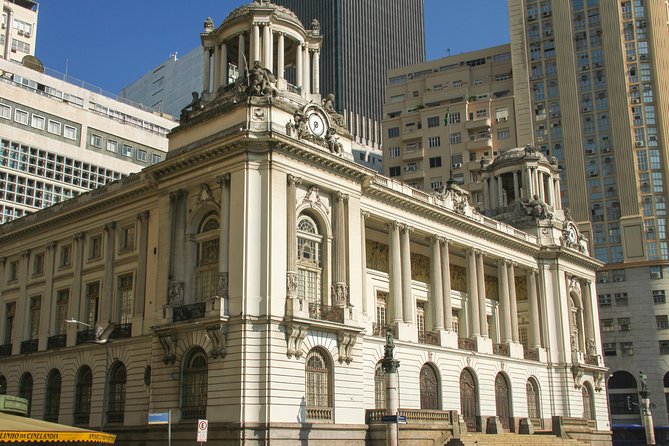
You’ll visit the Pedro Ernesto Palace, which houses the City Council of the municipality. The facade facing the square is described as symmetrical and packed with details, and the access staircase, upper gallery with double columns, and two tempiettos at the corners are called out as worth your attention.
Next is the Cultural Center of Federal Justice, highlighted as a space that encourages cultural access, hosting exhibitions, dance and music shows, courses, seminars, and lectures. This is not just a building stop. It’s a reminder that public spaces can be cultural spaces, even in government-linked zones.
Then you’ll reach the Tiradentes Palace, noted for Corinthian columns and an eclectic style. Historically, it was the National Congress seat from 1926 to 1960, and today it serves as the State Legislative Assembly. If you’re the type who likes to understand who makes decisions in a place, this is a direct route to that understanding.
A practical thought: for a tour like this, your guide’s pacing helps you keep track of what matters. If you keep your notebook handy for a few key names you hear, you’ll get more out of the palace sequence.
Praça XV and Paço Imperial, where Rio’s big moments happened
One of the most atmospheric parts of downtown is the area around Praça XV. The tour builds a story around what took place here, starting with the square’s Mestre Valentim fountain inaugurated in 1789, which is deactivated today.
You’ll also hear about the Church of Our Lady of Monte do Carmo in the area, and a particularly significant historic moment: in 1888, the square was the scene of celebrations for the Golden Law signed by Princess Isabel, when slavery was extinguished in Brazil.
Even if you already know the headline of that history, seeing it tied to a physical square helps it stick. You can walk through and picture the scale of the celebration, then realize how public space holds public memory.
From there, you go to Paço Imperial. This is described as a colonial building built in the 18th century as the residence of the governors of the Captaincy of Rio de Janeiro. Later it became the residence of Dom João VI when the court arrived in Rio, and it also housed Brazil’s emperors. After the Proclamation of the Republic, the Post and Telegraph were located there, and in 1938 it was listed as heritage. Since 1985, it has operated as a cultural center linked to Brazil’s historical and artistic heritage institute, and it has free entrance all year round.
This is a big value point. Free access to a site with that kind of layered past makes the walk feel like more than a paid guide service, it’s also access to core downtown culture.
More of Rio's older story on foot:
- Rio de Janeiro Historical Center Walking Tour★ 4.5 · 336 reviews
- Private Walking and Cultural Tour Rocinha-Rio de Janeiro★ 5.0 · 239 reviews
- Discover Rio Little Africa: A Cultural and Historical Journey★ 5.0 · 238 reviews
- Rio de Janeiro: Historic Rio and Santa Teresa Half-Day Tour★ 4.4 · 228 reviews
- Rio de Janeiro: Little Africa Heritage Walking Tour★ 4.9 · 177 reviews
Centro Cultural Correios and Travessa do Comércio for a more local feel
Downtown Rio has its grand monuments, but it also has lanes that feel like the city kept a secret. That shift happens on this tour with two stops that change the pace.
First is Centro Cultural Correios, set in a building with a history tied to plans that evolved. The facade is described with an eclectic style, and the building began as headquarters for a Brazilian Lloyd school, but the school plan did not happen. For more than 50 years, the building served administrative and operational post functions. It was disabled for reforms, reopened in 1992 in connection with the UN Conference on Environment calendar, and later officially inaugurated with Filatelia Brasiliana 93. Since then, it hosts events across theater, video, music, arts, and other cultural expressions.
Then comes Travessa do Comércio, an alley-and-alleys area near Praça XV. It is closed to car traffic and described as one of the few places in the city that preserves traits of colonial times. This is where you start seeing Rio differently, less as a list of attractions and more as lived-in street form.
If you like side streets because they help you understand how people actually move, this is the moment you’ll likely enjoy most.
CCBB and the Church of Our Lady of Candelaria for art and ritual
The tour also includes CCBB, the Cultural Center that consists of exhibition rooms, theaters, a library, cinema, and a video room. It’s housed in an art deco style building located in what used to be Rio’s financial district. Even if you do not spend long inside specific rooms, the building itself is part of the story: Rio transformed from finance to culture in a very physical way.
You’ll also visit the Church of Our Lady of Candelaria. It’s described as a Catholic temple in the center of Rio and one of the main religious monuments in the city. The tour notes it as a traditional stage for weddings of Carioca society.
That wedding detail is more practical than it sounds. It hints at a living tradition tied to downtown identity. It’s not a dead monument. It’s part of why people still choose the center for milestones.
The guide makes the difference: Senora Lu, Matilde, and Leonardo
A walk like this lives or dies on the guide. In the strongest examples of the tour, you’ll hear how guides bring the buildings to life and tie them to what Rio feels like now.
If Senora Lu is leading your group, you can expect a mix of fun and solid history, with plenty of room for questions that connect past details to daily life. Matilde is described as both well-prepared and considerate, even working in a coffee and pastry break for comfort during the day. Leonardo is described as friendly, passionate, and able to guide you through downtown streets in a way that makes the monuments feel personal, from churches to monuments to major interest points.
No matter who you get, the overall format is designed for personal attention. With a max of 14 travelers, you’re not one more face in a crowd. That helps you ask follow-ups, and it helps you keep the story straight when several landmarks have similar time periods or architectural styles.
Price, group size, and the value of a 4-hour downtown focus
The price is $74.50 per person for about four hours. That’s not cheap like a free walking map, but it is also not a luxury price either. For your money, you get three things that are hard to replace on your own:
First, you get coherent narration. Downtown Rio is dense. Without guidance, you might see many landmarks and still feel like you are only skimming facades.
Second, you get the subway component. Riding the metro as part of the plan saves time and makes the experience feel integrated into local movement.
Third, you get small-group pacing. At a maximum of 14 people, your guide can actually manage the flow, answer questions, and adjust to the group.
Also, this tour averages 46 days in advance booking, which is a useful signal. If you’re traveling in peak weeks, booking earlier increases your chance of getting the time slot and language you want.
My rule of thumb: if you want a structured downtown walkthrough with real context and you’re not trying to do everything independently, this is a good use of a half-day.
Who should book this Historical Rio walking tour
You should book if you want a guided downtown sampler that combines major landmarks with practical city navigation. This fits well if you like architecture, want to understand how Rio’s institutions developed, and enjoy learning through walking rather than sitting.
It is best for people with moderate physical fitness and for those comfortable wearing comfortable shoes, since much of the experience is on foot. It is not recommended for people with walking difficulties.
It also makes sense if you travel solo or with a friend and want a small group setting where your guide can interact with you, not just read from a script.
Should you book this Historical Rio walking tour?
I’d book it if your goal is to leave downtown Rio with names, context, and a stronger sense of how the city grew. The mix of metro, Cinelândia architecture, major cultural institutions, and the Paço Imperial and Praça XV area is a smart way to cover a lot in four hours without feeling like you’re sprinting.
Skip it only if long walking is a problem for you, or if you prefer a self-guided pace where you can linger for as long as you want without stopping for the group. For everyone else who wants a guided downtown hit with small-group attention, it’s a solid choice.
FAQ
How long is the Historical Rio Walking Tour?
It lasts about 4 hours.
What time does the tour start, and where do I meet?
The tour starts at 10:00 am. You meet at the entrance of Belmond Copacabana Palace Hotel, Av. Atlântica, 1702, Copacabana, Rio de Janeiro.
Where does the tour end?
The activity ends back at the meeting point.
Is food included in the tour price?
No. Food and drinks are not included.
Does the tour include a subway ride?
Yes. You ride the subway downtown, with a stop at Cinelândia station.
What group size should I expect?
The maximum group size is 14 travelers.
Is the tour suitable if I have walking difficulties?
It is not recommended for people with walking difficulties.
What happens if the weather is poor?
If canceled due to poor weather, you will be offered an alternative date.
Can I cancel for a full refund?
Yes, you can cancel up to 24 hours in advance for a full refund.
Recently added around Rio



Walking Tours, compared.



3 Hour Rocinha Favela Walking Tour with a Local Guide
Read our review →
Favela Tour Rio de Janeiro – Vidigal Walking Tour by Russo Guide
Read our review →
Private Walking and Cultural Tour Rocinha-Rio de Janeiro
Read our review →

Sunrise and Sunrise Walk Two Brothers with Local Guide
Read our review →More of this kind of Rio day