
Reviewed · TIJUCA RAINFOREST TOURS
Tijuca Forest w/ Chinese View,cascatinha Taunay,horto waterfall and parque laje
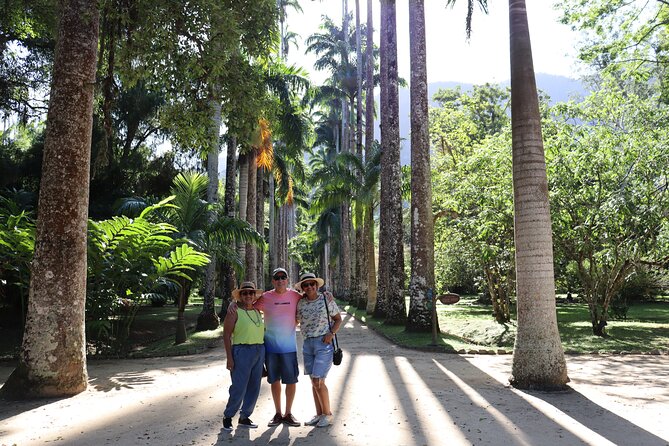
Rio has a rainforest day built in.
This route takes you into Tijuca National Park and pairs big city lookouts like Vista Chinesa with real forest time. I love that it mixes viewpoints, waterfall scenery, and a neighborhood stop in one tight plan.
My two favorite parts are the story you get at the lookouts, and the wildlife chances in the trees. The program connects the Chinese presence in Rio to places like the tea-cultivation monument and the older Royal Family rest stop called Emperor’s Table, so the scenery feels earned, not random. And at Parque Lage and around the forest, you may spot monkeys and toucans, which is a great reminder you are still in nature even though Rio is right there.
One possible drawback: you are asking for a forest day, so weather matters. Since the tour requires good weather, a wet day can change your plans.
In This Review
- Key points before you go
- Tijuca in a half-day format, and why it feels efficient
- Vista Chinesa Chinese View, tea-planter legend, and the steep climb payoff
- Emperor’s Table lookout: the Chinese labor road story on Alto de Boa Vista
- Cascatinha Taunay: the Roman-arch bridge, the artist’s house, and a real waterfall stop
- Parque Lage in the Jardim Botânico area: Atlantic Forest, old mansion vibes, and a forest pause
- Price and logistics: what $88.21 gets you, and what it does not
- Best for you if you want nature plus history, not just one or the other
- Should you book the Tijuca Forest with Chinese View, Cascatinha Taunay, and Parque Lage?
- FAQ
- FAQ
- How long is the tour in total?
- What is the group size limit?
- Are entrance tickets included?
- Is transportation included?
- Are snacks or bottled water provided?
- Does the tour require good weather?
- Can I cancel for a full refund?
Key points before you go
- Vista Chinesa’s panoramic payoff comes after a steep climb on a paved trail, so go at your own pace.
- Chinese-themed viewpoints tie together tea cultivation, a pavilion on the hill, and older road-building labor stories.
- Cascatinha Taunay is more than a photo stop, with a Roman-arch stone bridge and a waterfall tied to the Tijuca River system.
- Parque Lage is a forest park inside the city, part of the Atlantic Forest and connected to Tijuca National Park.
- Small group vibe with a max of 14 people, plus guide-led pacing at each stop.
- You are paying mainly for the guide and transport, since multiple stops list free admission tickets.
More of the Tijuca forest:
- Rio de Janeiro Tijuca Rainforest Hike with Waterfalls and Caves
★ 5.0 · 1,082 reviews - Rio de Janeiro: Christ, Selaron Steps, and Tijuca Park Tour
★ 4.7 · 857 reviews - Rio de Janeiro: Guided Jeep Tour through Tijuca Rainforest
★ 4.3 · 740 reviews - Explore the Best of Tijuca Forest – Hike to Peaks, Caves & Falls
★ 5.0 · 713 reviews
Tijuca in a half-day format, and why it feels efficient
This is a 4-hour, half-day style outing, which is perfect if you want the “Rio nature” fix without losing an entire day. You get a guided route that hits several highlights at a sensible tempo, so you are not spending your morning just getting to one far-off place.
The biggest value for me is that the tour is designed for movement. You are transported by car or jeep, and the stops are close enough to keep the momentum going. The group size stays small, up to 14 travelers, so the guide can manage the pace and help you get your bearings fast at each viewpoint and forest section.
I also like that the stops are varied. You start with two hilltop lookouts, which give you wide views and a sense of where Rio’s southern zone sits. Then you shift into waterfall heritage and a forest park tied to the Atlantic Forest. That rhythm matters, because pure lookout hopping gets repetitive, and pure forest wandering can feel aimless. This gives you both, with context.
The one “watch your expectations” point: this is not a long hike marathon. Some parts are steep, especially the climb for Vista Chinesa, but the overall time is short, so you will likely move with the group. If you want a slower, all-day forest immersion, you might need a longer excursion.
Vista Chinesa Chinese View, tea-planter legend, and the steep climb payoff
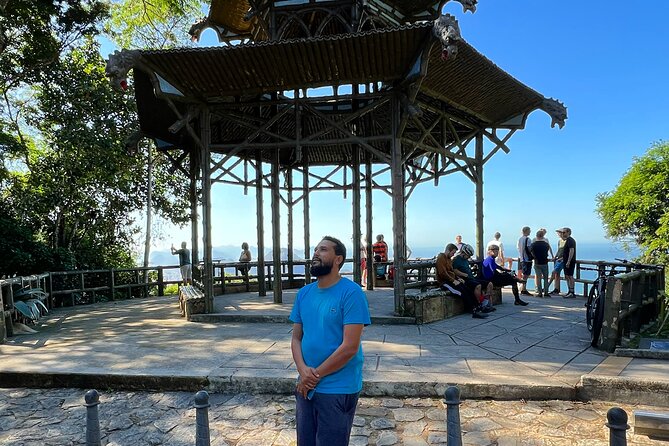
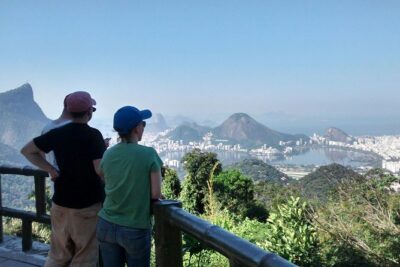
Vista Chinesa is the first big sensory hit. It is a monument from the early twentieth century connected to Chinese and tea cultivation in Brazil, and it sits where you can see a panorama over Rio’s southern zone. The practical win is that the trail starts with easy access and is fully paved, which helps on a first forest day.
Then comes the part to respect: the climb to the lookout is described as demanding and steep. This is where comfortable shoes and a slow, steady pace become your best tools. You do not have to sprint for a good photo, and you should not feel rushed here, because the payoff is the wide view at the top.
What I find especially interesting is how the tour connects the Chinese theme to specific local details rather than just using it as a label. The broader idea is that tea cultivation and Chinese involvement are part of Rio’s historical web, and Vista Chinesa is one of the places that keeps that thread visible. Even if you do not care about history, the viewpoint itself is worth it, because from up there the city looks like it shrinks under a green roof.
If you are the type who likes meaningful stops, this one works. You get a viewpoint plus a reason it exists. That combo is why this stop tends to be remembered long after you return to the beach.
Emperor’s Table lookout: the Chinese labor road story on Alto de Boa Vista
After Vista Chinesa, the tour moves to Emperor’s Table, also tied to Alto de Boa Vista and the Royal Family’s outdoor routines. The name alone sounds dramatic, and the backstory helps it make sense. The area connects to a botanic garden relationship with Alto de Boa Vista via a cantilevered road that was opened with influence from the Baron of Bom Retiro.
Here is where it gets human and complicated in a good way. The site records that workers were brought from China (from Macau) to work on rice crop development. The crop did not succeed, and those workers were later used to build the road instead. So you get a story of ambition, failure, and how people’s lives redirected.
The monument details also matter. There is mention of a pavilion called Vista Chinesa, built by Mayor Pereira Passos in 1903 with a project by architect Luis Rey, using mortar that copied bamboo. That is a neat example of how people tried to reproduce style and identity in stone and structure, even in a place far from where it started.
In practical terms, Emperor’s Table is another lookout and rest point, not a long museum-style visit. You likely get short time up top, enough to take in the view and absorb the story without turning it into a lecture. It is a great stop to pair with the first viewpoint, because together they help you understand why these hilltop structures are so tied to Rio’s development.
Cascatinha Taunay: the Roman-arch bridge, the artist’s house, and a real waterfall stop
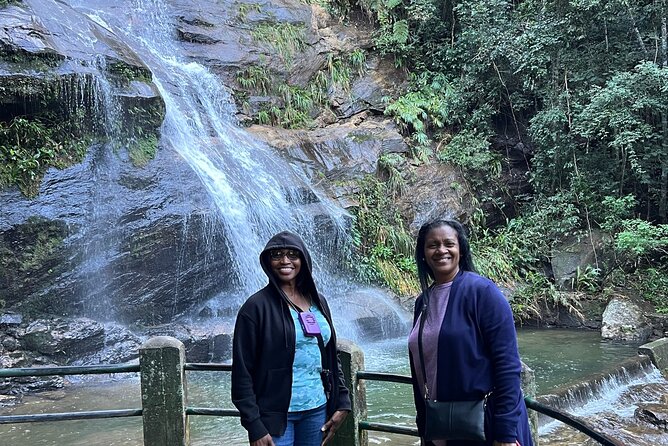
Then you reach Cascatinha Taunay, and this is the moment the trip shifts from history-in-viewpoints to water-and-forest. The waterfall area is anchored by a stone bridge built in 1860 by engineer Job de Alcântara, described in Roman-arch format. You can picture the scene easily, because the bridge is right in front of the cascade.
The waterfall itself is described as the highest waterfall in PNT, formed by waters from the Tijuca River, the Conde River, and other tributaries. Even if you do not memorize the names, the key idea is that the falls are fed by multiple river sources, so it is not just a trickle. It is a real system, which helps when you are trying to understand why Tijuca’s waterfalls can look so full.
The tour also brings in the arts angle, which I love because it makes the forest feel like a long-term conversation, not a one-time event. In 1817, artist Nicolas Antoine Taunay built a small house near the cascatinha and immortalized the beauty of the waterfall in his pictures. He even became a host of the forest, organizing meetings for the court. Later, the house was demolished in 1946, and the old Cascatinha restaurant was built there.
Right now, the old restaurant is being prepared and refurbished to become a café and new restaurant. So even if you just want a quick rest, there is potential to pause and regroup at the waterfall area, depending on what is open.
One practical tip: treat this stop as your photo-and-calm time. You will have seen lookouts above the canopy, and now you come down into the sensory layer, cooler air, misty views, and that waterfall sound. That contrast is exactly what makes the outing feel like more than one long walk.
Parque Lage in the Jardim Botânico area: Atlantic Forest, old mansion vibes, and a forest pause
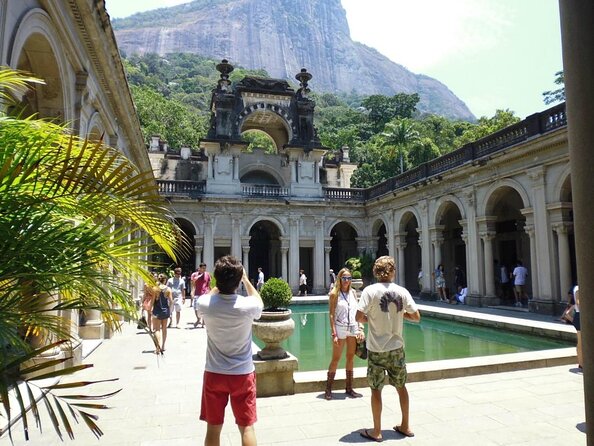
Parque Lage is a different kind of highlight. It is located in the Jardim Botânico neighborhood in Rio’s south zone, near big landmarks like the Jardim Botânico area and Cristo Redentor. The size is real, 52 hectares of forest, and the park is surrounded by the Atlantic Forest while also being part of Tijuca National Park.
What I like about Parque Lage for this specific tour is that it acts like a breather between viewpoints and waterfall time. You are still in forest, still in the greenery, but the stop gives you a different mood. It is also the place where you can see how Rio’s nature is not isolated, it is woven into the city’s map.
In a practical sense, Parque Lage is also where wildlife chances can pop. You might see monkeys up in the trees, and toucans are a possible surprise. I would not bet your day on a specific animal, but the fact that wildlife sightings come up during this route is a good sign that you are in the right ecosystem at the right time.
The old mansion angle is another reason this stop sticks. One of the better moments described is walking through the forest and then having a drink at the gorgeous old mansion. Because the tour data does not say drinks are included, just treat it as a chance, not a guarantee. If something is open when you arrive, it can be a great way to slow down for a moment without losing energy before the next viewpoint.
The time here is about 50 minutes. That is long enough to feel like you did something, short enough that you do not lose the half-day structure. If you want a forest pause that still fits a tight schedule, this is that stop.
If this one is full, Rio has these as well:
- Rio de Janeiro: 6-Stop Highlights of Rio with Lunch★ 4.4 · 5,157 reviews
- Christ the Redeemer Entry Ticket by Corcovado Train★ 4.4 · 4,476 reviews
- Rio’s City Tour – Tickets for Christ, Sugar Loaf & Lunch included★ 5.0 · 4,389 reviews
- Full Day: Christ Redeemer, Sugarloaf, City Tour & Barbecue Lunch★ 4.5 · 3,142 reviews
- Rio de Janeiro: Rocinha Favela Walking Tour with Local Guide★ 4.8 · 3,052 reviews
Price and logistics: what $88.21 gets you, and what it does not
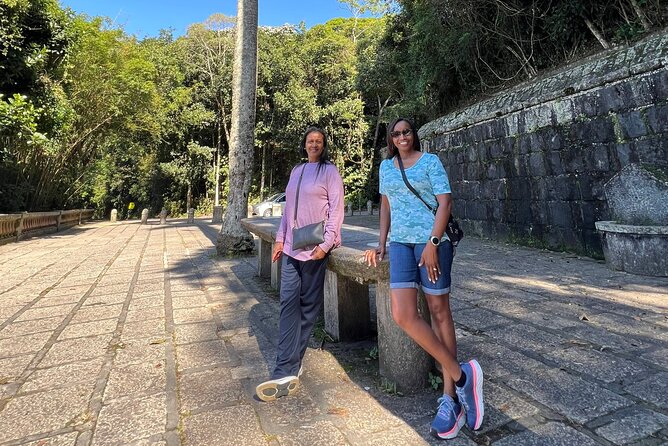
At $88.21 per person for about 4 hours, you are paying for a guided route plus transport. The itinerary pieces also help the value equation, because multiple stops list free admission tickets. That means your money is mostly going to the service, not entrance fees piling up.
Transport is also included, with car or jeep service as part of the experience. For larger groups, the vehicle can scale, while smaller groups are handled with convenience in mind. This matters because Tijuca and the viewpoints are easier with someone who knows where to park and how to sequence the stops.
Group size is max 14 travelers, which is a sweet spot. Too small can mean you lose some variety in pace, too big can mean you feel like cattle on a schedule. Here you get the best of both worlds: you get movement and guidance, without the kind of crowding that makes you stop caring about details.
Now, the “what to bring” part. Snacks and bottled water are not included. That is a real consideration on a humid forest outing, especially if you climb stairs or steep trails like the Vista Chinesa route. I suggest you plan to carry your own water, and bring a light snack if you normally get hungry during active sightseeing.
Also, the tour requires good weather. If it is rainy or conditions are poor, you can end up with a different date or a full refund. That is not a small thing, so check the forecast and keep your schedule flexible.
Best for you if you want nature plus history, not just one or the other
This tour is a strong fit if you want two things at once:
1) real forest scenery and a waterfall stop, and
2) context that explains why these sites exist, including the Chinese connections tied to tea cultivation and older development.
I especially think it suits people who like guided storytelling. The guide experience described here is repeatedly praised, with named guides such as Ederson, Jael, and Jabier coming up in positive feedback. That human factor matters, because on a short half-day, you need the guide to translate what you see into something you can actually remember later.
It is also a good choice if you care about small group comfort. Some feedback highlights a more one-on-one feel when the group is lighter, and with a max of 14, you generally avoid the chaos of large bus tours.
If you are traveling with someone who prefers quick wins, this tour can keep both of you happy. The lookouts give you immediate scenery, and the forest parks give you the calm, tree-heavy experience. The waterfall stop adds drama without turning the day into a full hiking event.
Should you book the Tijuca Forest with Chinese View, Cascatinha Taunay, and Parque Lage?
I would book it if you want a half-day that mixes viewpoints, a waterfall, and a forest park in Tijuca National Park, with free admissions at the stops listed. The price makes sense because your core costs are the guide and transport, and you are not getting nickeled-and-dimed by ticket fees.
I would hesitate only if you hate weather uncertainty or you prefer long, slow hikes. Because the program depends on good weather, it is not the best “set it and forget it” plan. And because the timing is tight, very slow walkers might feel the pace more than they want.
If your goal is to see why Rio’s rainforest is famous, while also learning how that landscape connects to Chinese-themed sites like Vista Chinesa and Emperor’s Table, this is a smart way to do it in one afternoon.
FAQ
FAQ
How long is the tour in total?
It runs for about 4 hours.
What is the group size limit?
The tour has a maximum of 14 travelers.
Are entrance tickets included?
Admission tickets for the listed stops are free.
Is transportation included?
Yes. The experience includes a tour guide and car or jeep transportation.
Are snacks or bottled water provided?
No. Snacks and bottled water are not included.
Does the tour require good weather?
Yes. The experience requires good weather. If it is canceled due to poor weather, you will be offered a different date or a full refund.
Can I cancel for a full refund?
Yes. You can cancel up to 24 hours in advance for a full refund.
Recently added around Rio


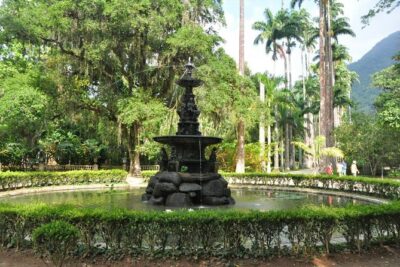



Tijuca Rainforest Tours, compared.

Rio de Janeiro Tijuca Rainforest Hike with Waterfalls and Caves
Read our review →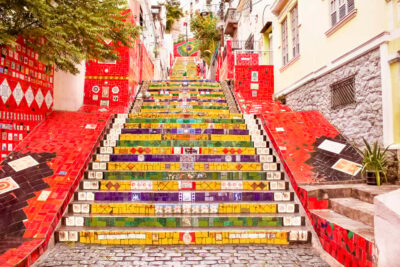
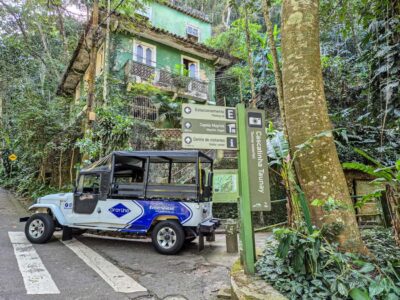
Explore the Best of Tijuca Forest – Hike to Peaks, Caves & Falls
Read our review →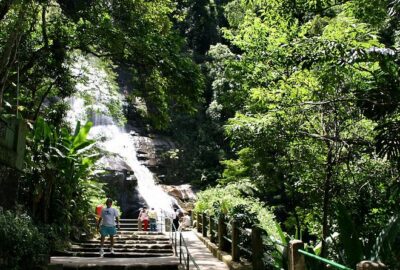
Jeep Adventure: Guided Tour through Tijuca Rain Forest
Read our review →
Tijuca Forest Small Group Hike to Caves and Waterfalls
Read our review →
More of this kind of Rio day