

Reviewed · CITY TOURS
Pedicab Tour of the Historical City Centre in Rio De Janeiro
Rio’s Centro is best seen slow. This 3 hour 30 minute pedicab tour strings together grand theaters, colonial palaces, street art, and UNESCO weight. You stay above the traffic and heat, hopping on and off when a stop is worth a longer look.
What I like most is how it mixes big landmark time with short, high-impact photo stops. Two highlights for me: the chance to see iconic spots like Selarón’s tiled staircase and Cais do Valongo without making your legs do everything, and the way guides (often Michael or Carlos) keep the ride relaxed with clear explanations and practical check-ins like water and bathroom breaks.
One thing to consider: a few major stops have admission tickets not included, so you may want extra cash or time for choices like Theatro Municipal, Tiradentes Palace, Museu do Amanhã, and the Rio Star add-on.
In This Review
- Key Things I’d Plan Around
- Why a Pedicab Through Rio’s Center Works
- Price, Timing, and What You Get for About 3.5 Hours
- The Ride Experience, From Meeting at the Municipal Theater
- Stop 1: Theatro Municipal do Rio de Janeiro, A Paris-Style Favorite
- Stop 2: Palacio Pedro Ernesto and the Power of Neoclassical Rio
- Stop 3: Cinelândia Square at Amarelinho
- Stop 4: Arcos da Lapa, the Aqueduct That Became a Viaduct
- Stop 5: Escadaria Selarón, 2,000+ Tiles of Pure City Art
- Stop 6: Palácio Tiradentes, Neoclassical Brazil in Government Colors
- Stop 7: Paço Imperial, Portuguese Governors to Brazilian Crown
- Stop 8: Praca Quinze de Novembro and the Telles Arch Alley
- Stop 9: CCBB Rio, a Historic Bank Turned Culture Center
- Stop 10: Church of Our Lady of the Candelária and Republic-Era Meaning
- Stop 11: Museu do Amanhã Perimeter Photos at Calatrava’s Future Design
- Stop 12: Painel Etnias, the World’s Largest Graffiti Mural
- Stop 13: Rio Star at the End of the Olympic Boulevard, Optional Wheel and Aquarium
- Stop 14: Cais do Valongo, UNESCO Weight at Brazil’s Slave Port
- Stop 15: Pedra do Sal, Samba Roots in Saúde
- Stop 16: Morro da Conceição, Colonial Streets, Fort Views, and Lunch Nearby
- Value and Who This Tour Fits Best
- Should You Book This Pedicab Tour of Rio’s Historic Center?
- FAQ
- How long is the pedicab tour?
- What does it cost per person?
- How many people are in the group?
- Are entrance tickets included?
- What is the meeting point and where does the tour end?
- Is the tour dependent on weather?
Key Things I’d Plan Around
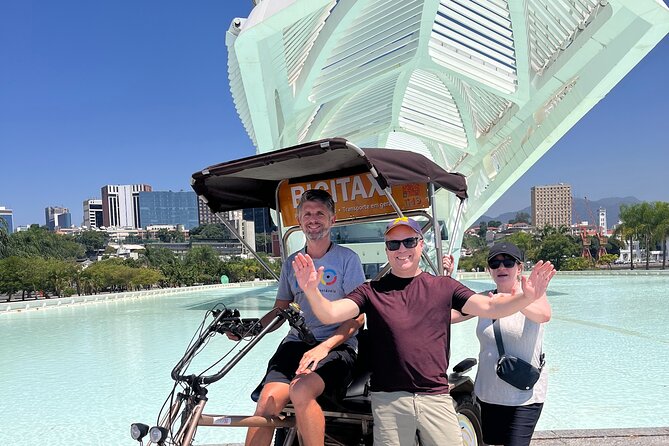
- Small group size (max 8) for a calmer ride and easier stopping.
- You cover huge ground without walking through long, hot stretches of Downtown Rio.
- Guide storytelling with practical pacing from Michael and Carlos, with photo help when you ask.
- A smart mix of places from Cinelândia and Lapa arches to UNESCO Cais do Valongo.
- Optional paid add-ons at Museu do Amanhã and Rio Star if you want more than viewing the perimeter.
- Weather matters since the experience requires good weather.
More of Rio's older story on foot:
- Rio de Janeiro Historical Center Walking Tour
★ 4.5 · 336 reviews - Private Walking and Cultural Tour Rocinha-Rio de Janeiro
★ 5.0 · 239 reviews - Discover Rio Little Africa: A Cultural and Historical Journey
★ 5.0 · 238 reviews - Rio de Janeiro: Historic Rio and Santa Teresa Half-Day Tour
★ 4.4 · 228 reviews
Why a Pedicab Through Rio’s Center Works
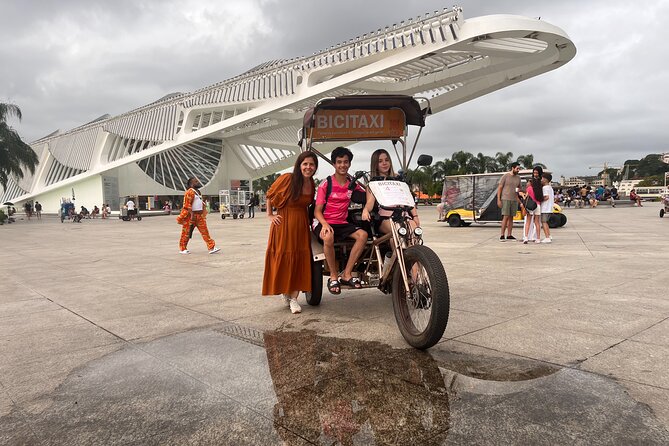
Rio de Janeiro rewards curiosity, but the Centro area can wear you out fast. This pedicab format makes sense because you get a steady flow of sights while avoiding the heavy walking that can turn a historic day into a sweaty scramble. Instead of white-knuckling it through crowds, you get time at key corners, facades, and viewpoints.
The second reason I’d pick this style is comfort with flexibility. You’re not stuck in one long walking route. The guides can adjust how long you linger, and you can still hit the big hitters in a tight 3 hour 30 minute window. That is a lot of Rio, measured in real time.
Price, Timing, and What You Get for About 3.5 Hours
The price is $70.57 per person, and the tour runs about 3 hours 30 minutes. That sounds like a lot until you factor in distance. In one outing, you’re seeing theaters, palaces, churches, a massive graffiti mural, a UNESCO port site, and views along the port area.
This small-group ride is also booked ahead quite often, with an average of 40 days in advance. If your dates are fixed, I’d plan early. A maximum of 8 travelers helps keep the tour from feeling like a moving traffic jam.
The Ride Experience, From Meeting at the Municipal Theater
You start at the Theatro Municipal of Rio de Janeiro, Praça Floriano, S/N, in Centro. The tour ends back at the same meeting point, which is handy if you’re planning dinner or heading toward your next stop afterward.
During the ride, the best part is that the guide keeps the day moving at a pace that feels doable. In past tours with Michael and Carlos, the rhythm has been described as not rushed and relaxing. You also get regular check-ins, like when to grab water early on and when it makes sense to pause.
Stop 1: Theatro Municipal do Rio de Janeiro, A Paris-Style Favorite
The tour kicks off at Theatro Municipal do Rio de Janeiro, about a 10 minute stop. This is Rio’s architectural showpiece on the first grand avenue, inspired by the Paris Opera House. Even if you do not go inside, the exterior sets the tone. It tells you you’re in the era of big public buildings and serious design.
Admission ticket note: admission is not included here, so if you want interior time, plan on paying separately. For many people, the exterior alone is worth it just for the scale and symmetry.
Stop 2: Palacio Pedro Ernesto and the Power of Neoclassical Rio
Next is Palácio Pedro Ernesto, home to the Municipal Chamber of Rio de Janeiro, with a 5 minute stop. This one is pure neoclassical drama: grand columns, intricate sculptures, and an opulent interior tied to the city’s political life. The palace was inaugurated in 1923, and it has served as the legislative seat since then.
The good news is that the stop is free for entry time. Even for a short stop, it gives you a sense of how Rio’s government buildings echo European styles, but with local flair.
Other loops of the city:
- Rio’s City Tour – Tickets for Christ, Sugar Loaf & Lunch included★ 5.0 · 4,389 reviews
- Full Day: Christ Redeemer, Sugarloaf, City Tour & Barbecue Lunch★ 4.5 · 3,142 reviews
- A Day in Rio – City Tour★ 4.5 · 1,128 reviews
- Christ the Redeemer & Sugarloaf: Rio City Tour with Lunch★ 4.5 · 717 reviews
- Rio: Carnival Backstage Tour at Samba City with Cocktail★ 4.6 · 520 reviews
Stop 3: Cinelândia Square at Amarelinho

You then roll into Cinelândia Square for a 5 minute look at Amarelinho, an iconic bar and restaurant that’s been around since the early 20th century. It’s the kind of place locals use as a meeting point, which makes it more than a photo stop.
This is mostly about atmosphere and context. If you’re hungry later, it helps to have a real name in mind from Downtown Rio. Entry is free for the visit time here, and the stop is short enough that you usually do not feel like you’re losing momentum.
Stop 4: Arcos da Lapa, the Aqueduct That Became a Viaduct
A highlight for almost everyone is Arcos da Lapa, also called the Carioca Aqueduct. You get about 5 minutes here. The structure has 42 arches stretched across 270 meters, built in the 18th century to move water from the Carioca River. In the early 20th century, it was repurposed for the Santa Teresa tram, so this place is both old engineering and living transit history.
You can get great street-level photos here, especially from angles that show the arches lining up into the distance. The stop is free, and it’s one of those stops where even short time feels satisfying.
Stop 5: Escadaria Selarón, 2,000+ Tiles of Pure City Art
Then comes the star of the visual show. Escadaria Selarón is a 15 minute stop, and it’s one of the most talked-about pedestrian artworks in the city. The staircase connects Lapa and Santa Teresa, with 215 steps covered in over 2,000 tiles from more than 60 countries.
Each tile is part of a larger, ongoing mosaic created by Chilean artist Jorge Selarón over more than two decades. The best way to enjoy it is not just to snap and move. Take a few minutes to notice how the colors shift and how people interact with the space. It’s also a great spot to ask your guide to help with a quick photo, since that’s been part of the experience for many guests.
Stop 6: Palácio Tiradentes, Neoclassical Brazil in Government Colors
Palácio Tiradentes is next for about 5 minutes. Completed in 1926, it originally served as the seat of Brazil’s Chamber of Deputies. Today, it houses the Legislative Assembly of the State of Rio de Janeiro.
The building’s neoclassical façade, with grand columns and detailed sculptures, gives a strong sense of how power was displayed through design. Admission ticket not included here, so if you want interior views, you’ll need to plan for that separately. For most people, the exterior gives enough to understand why it’s important.
Stop 7: Paço Imperial, Portuguese Governors to Brazilian Crown
At Paço Imperial, you get about 5 minutes. This is an 18th century colonial gem in Rio’s historic center, originally built as a residence for the Portuguese governors. Later, it served as a royal palace for the Portuguese royal family and the Brazilian imperial family.
What I like about this stop is that it’s not stuck in the past. Today, Paço Imperial functions as a cultural center hosting art exhibitions and concerts. It’s an easy place to connect colonial-era power to the arts scene Rio became known for. Entry time here is listed as free.
Stop 8: Praca Quinze de Novembro and the Telles Arch Alley
You then visit Praca Quinze de Novembro for about 10 minutes. Around this square are several historic layers, and the tour focuses on a few key ones. You’ll enter the Telles arch from the 18th century, which leads to a narrow alley lined with bars and restaurants that evokes old Rio.
The tour also includes the site of the old municipal market, plus a viewpoint toward Guanabara Bay and the Fiscal Island palace. This is a useful pause because it gives you a “map in your head” feeling for where the city’s core sits relative to the water.
Stop 9: CCBB Rio, a Historic Bank Turned Culture Center
Next is Centro Cultural Banco do Brasil (CCBB) for about 10 minutes. The building dates to 1906 and is neoclassical, originally a bank. Now it hosts art exhibitions, theater performances, films, and educational programs.
Even if you only see parts of the exterior and immediate areas, CCBB is a strong example of how Downtown Rio repurposes old institutional space for public culture. It’s free for this tour stop, and it’s often a place you can choose to return to later if something is on.
Stop 10: Church of Our Lady of the Candelária and Republic-Era Meaning
A major spiritual and political stop is Igreja de Nossa Senhora da Candelária. You’ll spend about 10 minutes here. Construction began in the late 18th century and finished in the 19th century. The church mixes Baroque, Neoclassical, and Renaissance styles.
The church is not only admired for its exterior and ornate interior, but also remembered for national events. It has been linked to the Proclamation of the Republic in 1889. Entry time here is free, and even short time works because the architecture and interior details are designed to hold attention.
Stop 11: Museu do Amanhã Perimeter Photos at Calatrava’s Future Design
Then you get a left turn into science and design with Museu do Amanhã, about a 20 minute stop. The museum is futuristic and was designed by Spanish architect Santiago Calatrava, with a structure described as dynamic and focused on sustainable design.
Here you do not enter. Instead, you pass the entire perimeter of the building for views and photo opportunities. This works well because you still get the “wow” of the architecture without adding museum ticket time to your day. Admission ticket not included, so if you want to go inside, you’d need separate planning.
Stop 12: Painel Etnias, the World’s Largest Graffiti Mural
Next is Painel Etnias, a mural by Brazilian artist Eduardo Kobra. This is about a 10 minute stop. It’s called the world’s largest graffiti mural and stretches 170 meters.
The mural depicts faces of indigenous peoples from five continents, meant to show human diversity and unity. It’s not just street art as decoration. It’s public communication at giant scale, and the color makes it an excellent break after architectural stops.
Stop 13: Rio Star at the End of the Olympic Boulevard, Optional Wheel and Aquarium
You’ll head to the end of the Olympic Boulevard for a quick look at Rio Star, including the Giant Wheel and aquarium attractions. The stop is about 5 minutes.
The tour notes a partnership with the Giant Wheel, so you may be offered a discount on admission if you choose to go in. Admission ticket not included, and this is best if you want one more paid attraction near the end of the ride. Even without tickets, it sets you up for an easy post-tour plan.
Stop 14: Cais do Valongo, UNESCO Weight at Brazil’s Slave Port
One of the most important stops is Cais do Valongo, about 10 minutes. This is a UNESCO World Heritage site designated in 2017. It served as the primary port for the arrival of enslaved Africans in the Americas during the 19th century.
The site was discovered during urban redevelopment in 2011, and it includes remnants of the original stone wharf and artifacts from the era. This stop is a reminder that Rio’s present city life sits on layers of painful forced migration. It’s free for this tour time, and it deserves a slower, quieter mindset than some of the louder landmarks.
Stop 15: Pedra do Sal, Samba Roots in Saúde
Then you move toward Pedra do Sal in the Saúde neighborhood for about 10 minutes. Historically, this site connected to the salt trade, and it was a gathering place for enslaved Africans and their descendants.
Today, Pedra do Sal is celebrated as a birthplace of samba music and a hub for Afro-Brazilian culture. Expect lively street life and the setting for rodas de samba. Entry is free, and it’s a meaningful cultural counterweight to the heaviness of Cais do Valongo.
Stop 16: Morro da Conceição, Colonial Streets, Fort Views, and Lunch Nearby
The tour usually wraps at Morro da Conceição for about 10 minutes. This historic hill offers charming colonial architecture, including narrow cobblestone streets, quaint houses, and old churches.
It’s also home to Conceição Fort, dating to the 18th century, where you can get panoramic views of the surrounding area. Beyond views, Morro da Conceição has art studios, galleries, and frequent cultural events.
The tour notes that it normally concludes with a corner that has three excellent lunch options nearby, including Italian, Mexican, and traditional Brazilian restaurants. That final stretch is practical, because you’re not left wondering where to eat after a full morning or afternoon.
Value and Who This Tour Fits Best
This is a great match if you want a lot of Rio’s core sights in one go, without turning your afternoon into a leg workout. It’s especially good for people who struggle with heat, uneven sidewalks, or the slow tempo of walking between far-apart districts.
It’s also a solid choice for mixed groups and families. One of the best signs is how the tour has worked for multi-generational groups, including kids, with a pace that does not feel like a sprint. The pedicab helps because you can keep attention on the guide’s stories while still giving everyone the comfort of a ride.
Where it may not fit is if you want museum depth at every stop. Several key places list admission tickets as not included, and the tour is designed around short visits and viewing time. You can still spend more time at add-ons, but you’ll need to decide in advance what you want paid ticket time for.
Should You Book This Pedicab Tour of Rio’s Historic Center?
Book it if you want a smart, small-group way to connect Rio’s biggest Centro landmarks to street-level culture, from Cinelândia to Lapa arches, then to Selarón Steps and out toward Cais do Valongo and samba roots. The pedicab format is the real value here, because it turns long distances into an easy ride and keeps the day relaxed.
I’d also book it early, since the average booking time is about 40 days in advance. And if you’re planning around interior ticket stops like Theatro Municipal, Tiradentes Palace, or Museu do Amanhã, do a quick budget check so you can choose confidently.
If you like architecture, public art, and stories tied to real places, this is one of the easiest ways to get your bearings fast in central Rio.
FAQ
How long is the pedicab tour?
It lasts about 3 hours 30 minutes (approx.).
What does it cost per person?
The price is $70.57 per person.
How many people are in the group?
The tour has a maximum of 8 travelers.
Are entrance tickets included?
Not always. Some stops list admission ticket not included, and others are listed as free admission for the visit time. Theatro Municipal and Tiradentes Palace have admission not included, Museu do Amanhã has admission not included, and Rio Star has admission not included. Other stops are listed as free.
What is the meeting point and where does the tour end?
The tour starts at the Municipal Theater of Rio de Janeiro, Praça Floriano, S/N – Centro, Rio de Janeiro – RJ, 20031-050, Brazil, and it ends back at the same meeting point.
Is the tour dependent on weather?
Yes. It requires good weather. If it is canceled due to poor weather, you’ll be offered a different date or a full refund.
Recently added around Rio




City Tours, compared.

Rio’s City Tour – Tickets for Christ, Sugar Loaf & Lunch included
Read our review →
Full Day: Christ Redeemer, Sugarloaf, City Tour & Barbecue Lunch
Read our review →

Christ the Redeemer & Sugarloaf: Rio City Tour with Lunch
Read our review →
Carnival Backstage Tour at Samba City with Cocktail
Read our review →

One Day Tour in Rio: Christ, Sugar Bread, Lunch and City Tour
Read our review →
Rio de Janeiro Private City Tour: Christ, Sugarloaf & More
Read our review →More of this kind of Rio day