
Reviewed · ESCADARIA SELARóN TOURS
Rio Downtown Tour with Selaron Metropolitan Cathedral and more
Rio downtown hits hard, fast. This 3-hour afternoon tour is a tight downtown sprint with real stops: Mosteiro de São Bento, the Metropolitan Cathedral, and then out to Lapa for the Selarón Steps and arched highlights. It is the kind of route that helps you get your bearings quickly, without turning your day into a commute marathon.
Two things I really like: the small group size (max 19) and the way the tour packs in big visual moments with guided context. I also appreciate that it is built for first-time visitors, with classic landmarks like Maracanã and the Sambadromo viewed from outside, while the time goes into places that are actually worth slowing down for.
The main drawback to plan for is tight timing. In good traffic, you get nice photo moments and guided explanations, but it is still a quick-hit tour, so you should not expect long, unhurried wandering at every stop.
In This Review
- Key points before you go
- Why the 1:30 pm Rio Downtown Route Works for Short Stays
- Maracanã and the Sambadromo: Big Scale, Quick Photos
- Avenida Presidente Vargas, Squares, and Palaces Without the Lost-Time Problem
- Metropolitan Cathedral of Saint Sebastian: Modern Design With Meaning
- Mosteiro de São Bento: A Living Abbey in Downtown Rio
- Lapa and the Carioca Aqueduct Arches: Neighborhood Energy in a Short Window
- Escadaria Selarón and Rua do Lavradio: Color, Craft, and Street Life
- Flamengo Bayfront at Aterro do Flamengo: A Drive With Real Views
- Price and Logistics: What $74.50 Really Buys You
- Tips to Get the Most From Short Stops and Busy Traffic
- Should You Book This Rio Downtown Tour?
- FAQ
- What time does the tour start, and how long is it?
- Where does pickup and drop-off happen?
- How big is the group?
- Are tickets included for the stops?
- What sights will I see during the tour?
- Can I cancel and get a full refund?
Key points before you go
- Mosteiro de São Bento visit with ticket included, and it is still an operating Benedictine abbey
- Metropolitan Cathedral (Cathedral of Saint Sebastian) is all about striking modern design and famous acoustics
- Maracanã + Sambadromo are quick look stops, not full stadium experiences
- Lapa Arches (Carioca Aqueduct) and the tram connection area give you the neighborhood feel
- Selarón Steps are 30 minutes of color and craft, credited to Jorge Selarón’s decades-long tile obsession
- Air-conditioned minivan + Zona Sul pickup helps you cover ground without exhausting logistics
More visits to the Selaron steps:
- Rio’s Full Day: Selarón Steps, Christ & Sugarloaf – Tickets & Lunch Included
★ 5.0 · 2,724 reviews - Rio: Christ the Redeemer, Sugarloaf, Selaron & BBQ Lunch
★ 4.5 · 2,428 reviews - Rio’s Best_Corcovado, Sugar Loaf, Selaron, Cathedral and more
★ 5.0 · 864 reviews - Rio de Janeiro: Christ, Selaron Steps, and Tijuca Park Tour
★ 4.7 · 857 reviews
Why the 1:30 pm Rio Downtown Route Works for Short Stays

This tour is scheduled to start at 1:30 pm and runs about three hours. That timing is smart if you have already done the big-ticket sights on other days and want a focused afternoon in Rio’s center. You get hotel pickup in Copacabana, Ipanema, or Leblon (Zona Sul), then head straight into downtown by air-conditioned minivan.
You also get an experienced, professional guide, and the group stays small, with a cap of 19 people. In practice, that usually means questions do not get lost in the shuffle. More importantly, it means the guide can keep the pace moving while still giving you enough story to understand what you are looking at.
Value check: you are paying $74.50 per person for guided transport plus multiple curated stops in a compressed window. It is not cheap for “just driving around,” but with multiple sights included and free entry at key points, it adds up better than many bus-style tours that only show you facades.
Maracanã and the Sambadromo: Big Scale, Quick Photos
The tour swings past Maracanã Stadium and the Sambadromo. The big idea here is scale. Even if you never step inside, you get the feel of how Rio stages major sports and huge public events.
Maracanã is treated as an outside moment. You get about 15 minutes, with time for pictures near a statue (Bellini’s statue is the reference point). The surrounding area is where you can wrap your head around why Maracanã matters: inaugurated in 1950, it is the largest stadium in Brazil and holds more than 78,000 fans.
One reason this stop works even for short tours: you get an immediate contrast. You see the stadium world on one side of Rio’s story, and then you transition to the older downtown streets and cathedrals on the other side.
If your expectations are “inside the stadium,” you will be disappointed. But if your goal is an efficient snapshot and orientation, the outside view is a solid use of limited time.
Avenida Presidente Vargas, Squares, and Palaces Without the Lost-Time Problem
After Maracanã and the event corridor, the route runs down Avenida Presidente Vargas. This is where the tour is at its best for people who want to understand Rio’s urban backbone without getting stuck in taxis or buses.
From the vehicle, you get viewpoints and quick context for major downtown landmarks, including the Central Railway Station, Duque de Caxias Palace, and Itamaraty Palace. You also pass sights around Campo de Santana, Tiradentes Square, and Avenida Chile.
The practical benefit is simple: you are covering multiple important streets in a short time block, which is hard to do on your own unless you plan carefully. Downtown Rio can be a bit of a maze, and traffic can stretch travel time. Here, the tour vehicle does the heavy lifting.
A note for your planning mindset: you will not “live” in these squares and buildings. Think of this portion as your visual map. Once you see where everything sits, you can decide what you want to return to later.
Metropolitan Cathedral of Saint Sebastian: Modern Design With Meaning
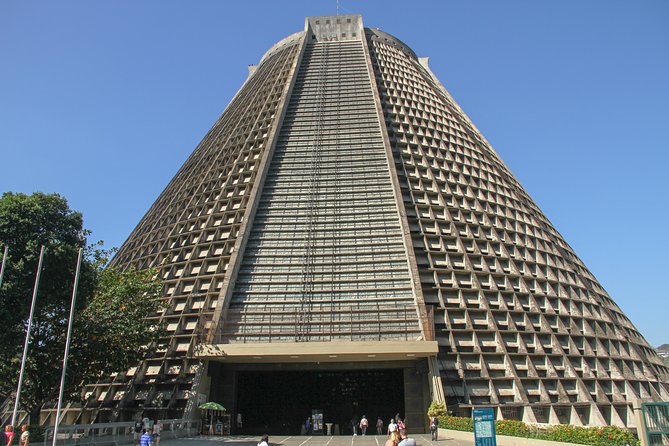
Then comes one of the tour’s stand-out architectural moments: the Metropolitan Cathedral of Saint Sebastian. You get about 30 minutes here, and entry is free.
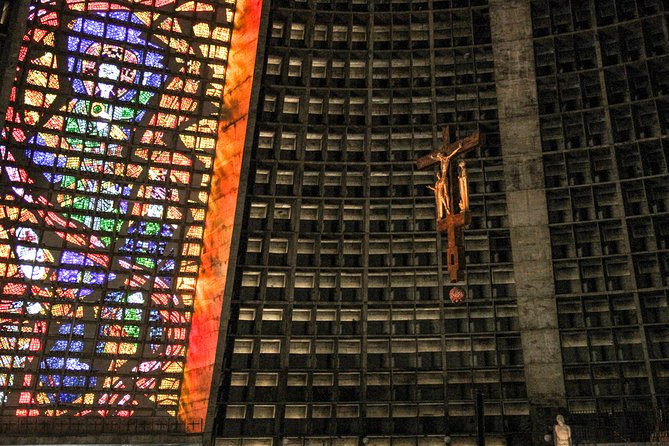
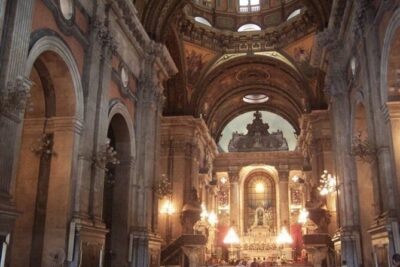
What makes it memorable is not just the shape. The design takes inspiration from Mayan pyramids in Mexico, using a conical form meant to create a sense of closeness to God. Inside, four stained-glass windows run from floor to ceiling, forming a cross shape at the top.
There is also a practical reason to care about this stop beyond photos: the cathedral’s acoustics are described as heavenly. Even if you are not there for a performance, that reputation helps explain why people treat it as more than a tourist stop.
This is the kind of place where your guide’s storytelling really matters. The architecture can look futuristic at first glance, but it becomes easier to appreciate when you know what it is trying to communicate.
Mosteiro de São Bento: A Living Abbey in Downtown Rio
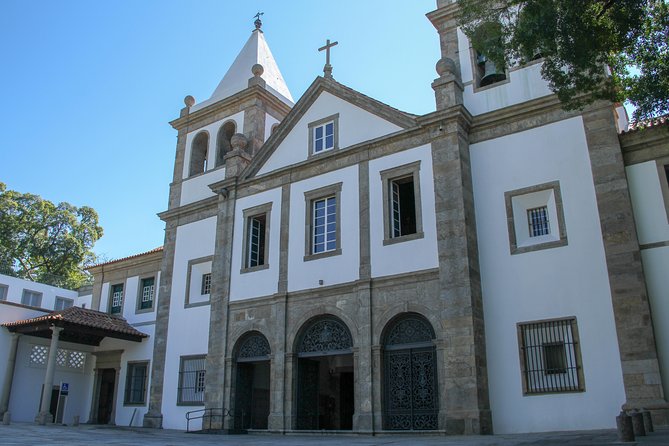
Mosteiro de São Bento, the Monastery of St. Benedict, is one of the most satisfying stops because it is not a museum scene. It is a functioning Benedictine abbey in downtown Rio.
You spend about 30 minutes here, and the admission ticket is included. The monastery was founded in 1590 by Benedictine monks who came from Bahia, and it is still operational today. Nearby there is also the Colégio de São Bento, which gives the area a sense of continuity rather than just “historic building tourism.”
Architecturally, the façade connects to its roots. The original Mannerist project included a centralized entry with three archways, plus a triangular gable and two towers with pyramidal spires. When you step through, you are met with a tiled porch and iron gates dating to the nineteenth century.
Why I like this stop for first-time visitors: it is a real slice of daily religious life, not only an object behind a fence. Even if you do not catch every detail, the place has a focused atmosphere, and the architecture feels intentional, not just decorative.
If this one is full, Rio has these as well:
- Rio de Janeiro: 6-Stop Highlights of Rio with Lunch★ 4.4 · 5,157 reviews
- Christ the Redeemer Entry Ticket by Corcovado Train★ 4.4 · 4,476 reviews
- Rio’s City Tour – Tickets for Christ, Sugar Loaf & Lunch included★ 5.0 · 4,389 reviews
- Full Day: Christ Redeemer, Sugarloaf, City Tour & Barbecue Lunch★ 4.5 · 3,142 reviews
- Rio de Janeiro: Rocinha Favela Walking Tour with Local Guide★ 4.8 · 3,052 reviews
Lapa and the Carioca Aqueduct Arches: Neighborhood Energy in a Short Window
Lapa is where the tour starts shifting from grand monuments into a more human, street-level vibe. You will see the neighborhood’s famous arches, known locally as Arcos da Lapa, which are part of the Carioca Aqueduct.
The aqueduct has been serving Rio since the end of the nineteenth century. Today it also supports a tram route that connects the city center with Santa Teresa uphill, via the Santa Teresa Tramway. That matters, because it ties the arches to movement and everyday life, not just a static landmark.
Even with a brief stop, this area gives you a sense of how downtown Rio connects layers of the city. It is a good moment to slow down, take photos, and feel the neighborhood geometry.
Escadaria Selarón and Rua do Lavradio: Color, Craft, and Street Life
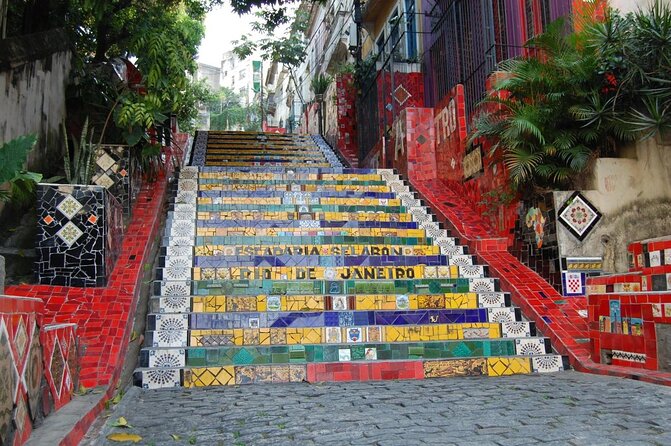
The tour’s most famous “wow” stop is the Escadaria Selarón (Selarón Steps). You get about 30 minutes here, and entry is free.
These steps are credited to Chilean-born artist Jorge Selarón, and they are often described as his tribute to the Brazilian people. The story is the point. In 1990, he began renovating dilapidated steps in front of his house. Neighbors initially mocked his bright tile choices, which used colors tied to the Brazilian flag: blue, green, and yellow.
What started as a side project became an obsession. Selarón kept working through financial hardship, funding the work by selling paintings, and eventually covered the entire set of steps with tiles, ceramics, and mirrors.
Here is why this stop works even in a short tour: you instantly understand it visually. Your guide can then add the backstory, which makes the colors feel like a personal message rather than random street art.
After Selarón, you also get time around Rua do Lavradio in Lapa for about 20 minutes. This street is known for antique shops and a cluster of bars and restaurants. It is active, and it has a street-fair rhythm too. On the first weekend of each month, there is a street fair that mixes tourists and locals.
This is a nice “breathing space” stop. It is not only architecture. It gives you a sense of where people actually hang out in Rio’s center.
Flamengo Bayfront at Aterro do Flamengo: A Drive With Real Views
To close the tour, you cruise down Aterro do Flamengo, the waterfront park between Botafogo and Flamengo districts. The park was built on reclaimed land, about 300 acres (roughly 1.2 square kilometers), and completed in 1965.
This is where you get the best “you are still in Rio” feeling. Gardens here were designed by landscape designer Roberto Burle Marx, and the drive along the bayfront puts you near several landmarks, including the Church of the Outeiro da Glória, the Monument to the Fallen in World War II, and the Museum of Modern Art.
The tour does not position this as a long sit-down sightseeing block. It is more like a final scenic stitch, helping you connect neighborhoods and see Rio’s waterfront energy before you head back.
If you like your travel to end with a view instead of another building, you will probably enjoy this portion.
Price and Logistics: What $74.50 Really Buys You
At $74.50 per person for about three hours, the question is not just cost. It is what you get for your time.
You receive:
- Hotel pickup and drop-off for selected Zona Sul hotels
- Air-conditioned minivan transport
- A professional guide
- Included admission for Mosteiro de São Bento
- Free entry at the Metropolitan Cathedral and Selarón Steps
You also get quick outside viewing for bigger-ticket places like Maracanã and the Sambadromo. Maracanã is not included as an inside admission experience, and the time is limited. That is not a flaw if you treat it like orientation. It is a mismatch if you want an event-day or behind-the-scenes experience.
The group size cap of 19 also matters for value. Bigger groups often mean shorter stops. Here, the small group structure makes it more realistic to hear stories, not just listen to background noise.
My practical take: this is a good booking if you want to see the center in a single afternoon. If your goal is deep museum time or long neighborhood wandering, you will likely want to pair it with something else later.
Tips to Get the Most From Short Stops and Busy Traffic
Downtown Rio is traffic-heavy at times, and this tour is intentionally built around a packed schedule. That means your best strategy is to prepare for photo moments and guided walk-bys, not long “linger and read every plaque” time.
A few smart moves:
- Wear comfortable shoes for the short stints where you will be standing and moving around steps and church areas
- Bring a camera that works fast, because Selarón and Lapa photos happen quickly
- Keep your expectations aligned with the route: some big landmarks are seen from outside, with shorter stops
- If you care most about one or two stops, decide ahead of time which ones you will treat as your priority moment
Also, pay attention to your guide style. This operator often assigns guides like Monica and Victoria who are known for being engaging and organized, and other names that come up are Arthur and Andre for efficient, safe routing. When the guide is sharp, it helps a fast route feel coherent instead of rushed.
Should You Book This Rio Downtown Tour?
Book it if you:
- Have limited time and want a strong introduction to downtown Rio
- Want a small-group experience with hotel pickup from Copacabana, Ipanema, or Leblon
- Care about architecture and iconic places like the Metropolitan Cathedral and Selarón Steps, not just check-the-box stops
- Would rather spend three hours moving with a guide than piecing together transport and timing on your own
Skip it if you want:
- Long interior visits at everything, or inside access at Maracanã
- A slow paced day with lots of free time for browsing
If you are doing Christ the Redeemer and Sugarloaf on other days, this afternoon route works like the city’s other half. You get the churches, the arches, the steps, and the waterfront in one clean loop. It is a practical way to get oriented, and it leaves you with clear targets for what to revisit later.
FAQ
What time does the tour start, and how long is it?
The tour starts at 1:30 pm and lasts about 3 hours.
Where does pickup and drop-off happen?
Pickup is for selected hotels in Zona Sul, including Copacabana, Ipanema, or Leblon. The tour ends back at the meeting point.
How big is the group?
The tour has a maximum of 19 travelers.
Are tickets included for the stops?
Mosteiro de São Bento includes an admission ticket. The Metropolitan Cathedral of Saint Sebastian is free, and the Selarón Steps are free. Maracanã is a quick outside stop and admission is not included.
What sights will I see during the tour?
You’ll see Mosteiro de São Bento, the Metropolitan Cathedral, Maracanã Stadium and the Sambadromo from outside, Lapa arches (Carioca Aqueduct), Escadaria Selarón, and you’ll cruise along Aterro do Flamengo, with views of landmarks along the bayfront. There is also a stop area for Rua do Lavradio.
Can I cancel and get a full refund?
Yes. You can cancel up to 24 hours in advance for a full refund. If you cancel less than 24 hours before the start time, the amount paid is not refunded.
Recently added around Rio




Escadaria Selarón Tours, compared.

Rio’s Full Day: Selarón Steps, Christ & Sugarloaf – Tickets & Lunch Included
Read our review →
Christ the Redeemer, Sugarloaf, Selaron & BBQ Lunch
Read our review →
Rio’s Best_Corcovado, Sugar Loaf, Selaron, Cathedral and more
Read our review →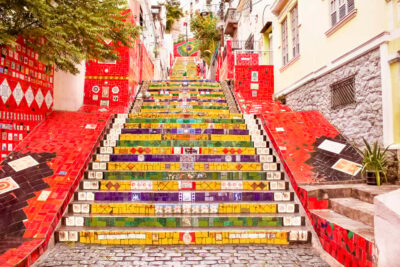

Full Day in Rio: Christ by Train, Sugarloaf, Selarón & Barbecue
Read our review →
Half-Day Tour: Christ the Redeemer, Selarón & Sunset at Sugarloaf
Read our review →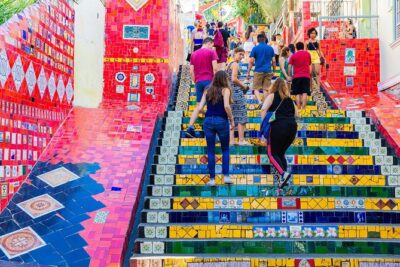

Santa Teresa, Lapa, and Cinelândia with Tram Ride and Selarón Steps
Read our review →More of this kind of Rio day